Let's make some early observations about the 2026 Royals
We're not jumping to conclusions. Not after four games. Observations.

I was traveling over the opening weekend of the season, so I've been lax in writing. I'm back at the desk now and don't feel like I missed much. I mean, the Royals didn't blow a lead in devastating fashion while I was away or anything.
Oh.
I've spent the last few hours digging through the MLB.tv archives so I could get fully up to speed. After this Royals baseball binge, I've made a few observations based on the first four games of the season.
The starting pitching has been mostly exceptional
I thought Michael Wacha was outstanding in his start on Saturday. He finished six shutout innings, allowing just three hits while striking out seven and walking just one. Regular readers know how much I love using Bill James’ Game Score formula for evaluating starting pitcher performance so I’ll note that Wacha finished with a Game Score of 72. It wasn’t his best since joining the Royals, but do put up that number in just six innings of work was crazy impressive.
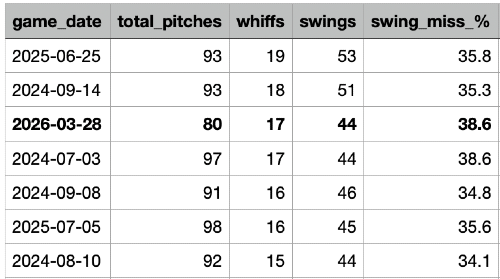
Wacha did it on the back of 17 swings and misses which was tied for the third most since joining the Royals. His high is 19 whiffs in a start, coming in June of 2025. Even more impressive was the fact those 17 whiffs came on just 80 overall pitches. His 38.6 percent whiff rate was tied for his best in his Royals career.
As you would expect from Wacha, he did the most of his damage utilizing his changeup. It’s always been his best offering. He generated nine swings on the change in Atlanta. He got four whiffs. Atlanta batters put three changeups in play with the average exit velocity on those three being 80.3 mph.
On Sunday, Seth Lugo wasn’t as dominant as Wacha, but still found a way to get results. That’s the definition of a wily veteran for you. Lugo flashed all nine of his pitches, relying mostly on his four-seam, regular curve and sinker. The way he used his pitches was a key to his approach. The curve didn’t really come into play until the second time through the order.
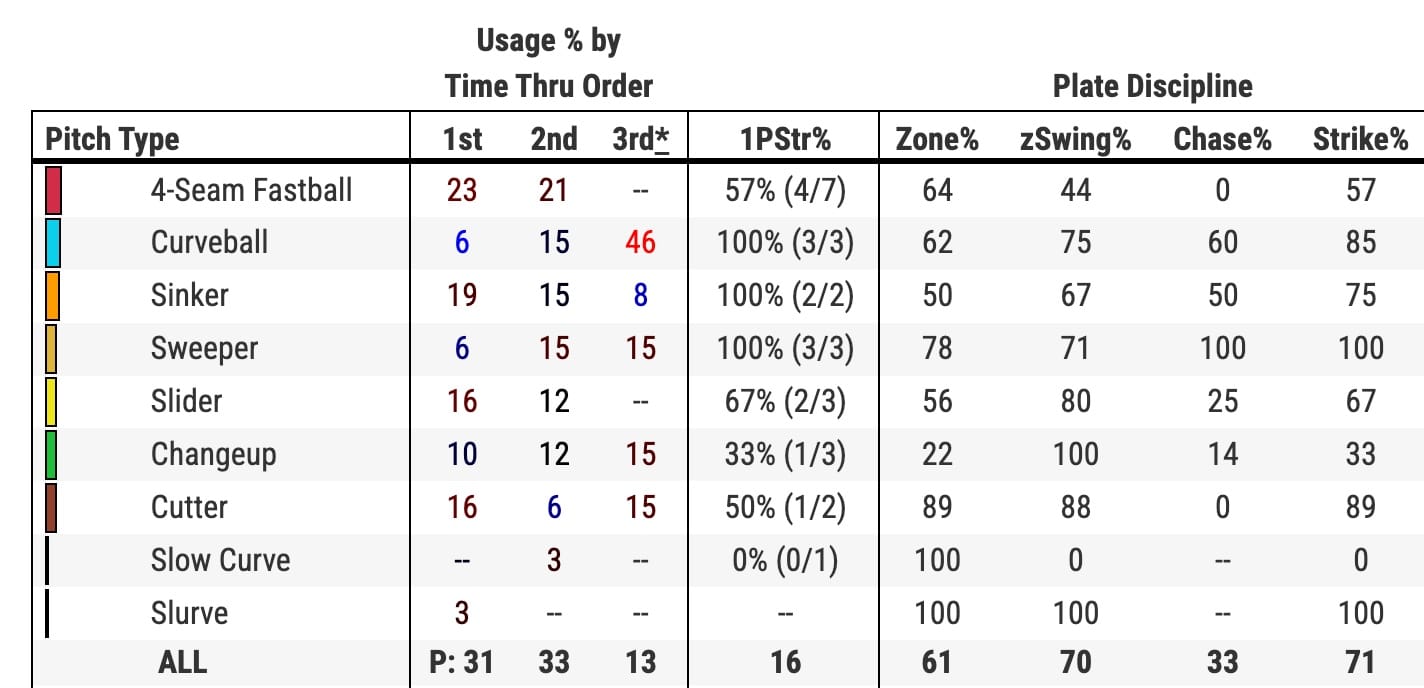
This kind of usage sort of feels like common sense when a starter has as many pitches in his arsenal as Lugo. Establish the fastballs the first time through the order with a good, hard slider as a flash of variety. The second time through, is where you fully introduce your secondaries like the curve and the sweeper, pitches that were delivered around 10-12 mph slower than the fastballs. Then on the third time through it’s heavy on the curve and sweeper.
From the table above, we see that Lugo got a first-pitch strike two-thirds of the time. That's exceptional.
We’ve been fetishized on punchouts and swings and misses on maximum velocity, but when you have a cerebral pitcher like Lugo on the mound with a number of options, this is the pathway for success.
Then came Kris Bubic in the home opener on Monday. He matched his veteran rotation mates, completing six innings. He allowed just two hits—one of which left the yard. It felt like vintage Bubic.
The lefty didn’t get as many strikeouts as he probably would’ve liked, instead relying on his defense. He also battled his command a bit, especially on his four-seamer which led him to walking three batters, which isn’t what you want to see. Yet he made the necessary adjustments and when you give up a lone single in addition to that solo home run, it’s manageable.
In a start last May at Baltimore, Bubic used his sinker 17 percent of the time. That was his high-water mark on the 2025 season. On Monday against the Twins, Bubic leaned on his sinker 21 percent of the time. Like Lugo before him, Bubic really unleashed the pitch the second time through the order to give Twins hitters a bit of a different fastball look. It was his first pitch of choice in nine of the 22 batters he faced.
I like that Bubic and Lugo tried a different approach to reach success. Wacha leaned on his cutter a bit more that usual, but found his success on his tried and true approach with the changeup. Overall, it was a fun way to see pitchers approach their craft utilizing different methods.
Even with Cole Ragans scuffling in his first start, the Royals starters own a collective 2.01 ERA, good for second best in the majors.
The offense is scuffling to put anything together
If you recall my bold predictions from a week ago, I made the prognostication that the 2026 Royals would have a top-tier offense. Through the first four games, we’re still waiting for the bats to get going. They’ve scored just nine runs.
They're not even stringing baserunners together. Five of those runs have come courtesy the long ball. In fact, the Kyle Isbel home run in the second inning of the home opener on Monday which came with a man on, has been the only time through the first 35 innings of the season the Royals have hung a crooked number on the scoreboard.
They are 2-16 with runners in scoring position. Their team OPS+ is 67, meaning they’re producing at a clip that is 33 percent below the league average offense. This feels all too familiar, doesn't it? I will remind all of us that this is all through four games of the season. They play 162. It is criminally insane to draw any conclusions from four games drawn at any point of the year, never mind the very first four.
I remain confident the offense will get going. But just one year I’d like for this team to come out of the gate hot. Is that too much to ask?
The Royals have a closer problem
I was traveling in the Pacific Northwest this weekend, so I wasn’t as plugged in to the action as I would’ve otherwise been. Although I was keeping track of Saturday's game through my phone while I was enjoying some Oregon wines in the Willamette Valley that provided this view:

During the Saturday game with Atlanta, I knew the score was 2-0 to the good as the game edged into the ninth inning thanks to a Salvador Perez home run and Atlanta gifting the Royals another run late in the game. Everything seemed peachy. The next time I checked my phone, I saw the 6-2 final in favor of Atlanta.
What? How could that be?
I then realized exactly what that meant…Oh my god…a walkoff grand slam.
And without even opening the box score, I knew what happened. I just knew, based on what transpired during spring training, that Carlos Estévez was on the mound. That, my friends, is what you would call an inevitable implosion of the closer.
There’s been plenty of gnashing of teeth over Matt Quatraro using Estévez on Saturday, but you know what? Quatraro was always going to use Estévez in that situation. He’s the anointed closer and it was the Royals first save situation of the season. That does not mean you have to like it. Who the hell likes it? But as long as Estévez broke camp with the team, he was always the ninth inning guy. That’s just how baseball is played and managed in 2026. I will make the argument that the Royals should've had someone throwing behind Estévez in the bullpen. Especially after the first two batters reached. I'm not sure the "who" matters because the pitcher would've been anyone but Estévez.
Maybe that comebacker that hits his ankle rolls by and is fielded by Bobby Witt Jr. who was shaded up the middle. Maybe Witt steps on second and fires to first to complete a game-ending and save-clinching double play. Maybe the Royals win on Saturday. I will posit that if that sequence unfolded as above, that would merely be delaying the inevitable. At some point very early in the season, Estévez was going to blow a game and do so in spectacular fashion. It just happened in the second game on the season on national television.
The question, I think, was why was Estévez on the roster to begin with? His velocity was down. Sure, the team could explain that away as it happened last year and he’s a veteran and he knows how to prepare and on and on and on. However, there were plenty of red flags all month. He's simply not right. Watching back his outing, his mechanics were clearly compromised and that was prior to taking a liner off his ankle. (When watching the archived game and knowing what was coming, I thoroughly did not appreciate the graphic that said the Royals were 73-0 last season when leading after eight innings. Sigh.)
Estévez and the Managerial Closer Guide cost this team the game. I’ll give a bit of credit to Quatraro and team that in the aftermath they were talking about deploying Estévez in lower-leverage situations.
“I mean, we’re not averse to putting him in a lower-leverage situation. We feel good about the rest of the options that we have, too. So I’m not going to say he wouldn’t do it, but I also think it would be probably smarter for us to try to build him a little bit in lower leverage first.”
Although with Estévez walking around in a boot the following day, he was an option for a no-leverage situation. Well, that and the fact he threw 27 pitches in that Hindenburg-esque ninth inning. Only 12 pitches went for strikes. Including the last one.
That meant Sunday’s save opportunity was handed to Lucas Erceg. He required just 12 pitches to get three outs in locking down the Royals first victory of 2026. If the Royals decide to go to closer by committee, or if they decide Erceg is the man, so be it. Estévez has to prove that he can be trusted before he's handed a ninth inning lead again.
Maybe this sorts itself out. Estévez was still in a walking boot on Monday. There was no news on Tuesday, but that was expected. I would not be surprised if the Royals made an IL move on Wednesday. The Royals have to figure out how to get Estévez right. They have the bullpen to cover for him, but they cannot afford to take chances and do this during games where they are protecting a late lead.
Salvador Perez is very good at challenging
I haven’t written anything about the new automated balls and strikes system (ABS) being used in the majors this year. My crankery on replay reviews is extremely well documented so you may be surprised to learn that I am very much in favor of this particular system. It’s not without its hiccups, but it seems good enough. And the two challenges per team per game (more if you get them correct) means there is a limit to any kind of shenanigans. The system is quick and relatively definitive and exposes C.B. Bucknor, so that is always a plus for me.
In particular, I enjoyed Friday’s game where Perez was a perfect three for three in challenges. He then added another on Saturday in the ninth inning in a key moment that bought Estévez a much-needed strike in the moment.
A current check of the ABS Leaderboard at Baseball Savant (through Monday's games) shows Perez is the current leader among catchers with four challenges resulting in flipping a ball to a strike. He's 4-5 in his first three games behind the dish. I will take a moment to savor the irony that one of the worst pitch-framers in the game might just be an exceptional judge of the strike zone.

At the home opener, the Royals honored Terrance Gore, who passed away in early February. His son Zane, threw out the first pitch to Alex Gordon. If you haven't seen this, you need to.
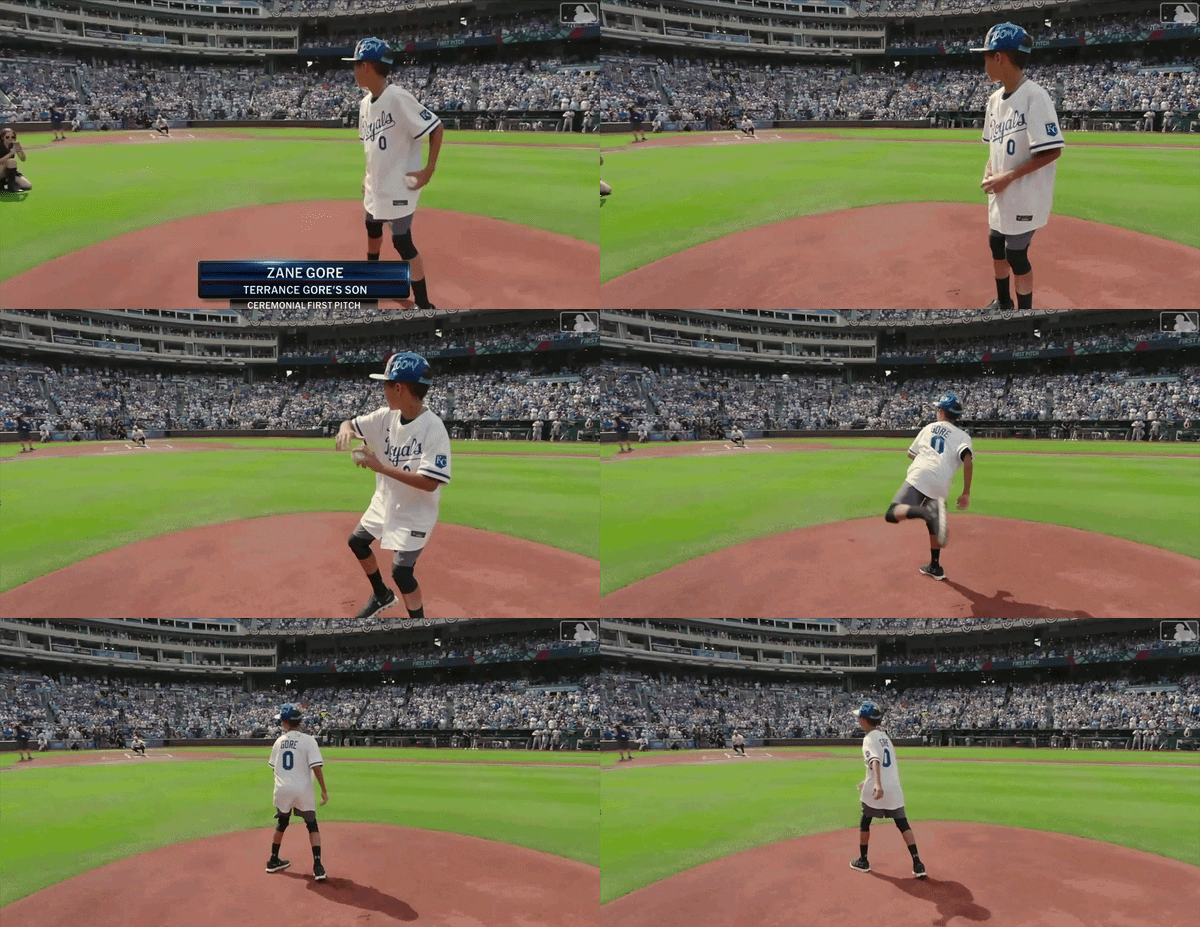
I cannot fathom how difficult it has been for the Gore family. I hope that moments like this can lift them up and give them a little bit of comfort.

Central Issues
White Sox 2
Marlins 9
Chicago jumped out to a 2-0 early lead but the Marlins struck for four in the fourth. That inning was highlighted (I'm not sure that's the proper descriptive word) by two throwing errors from Sox center fielder Luisangel Acuña. Liam Hicks, Owen Cassie and Griffin Conine each drove in a pair for Miami.
Tigers 5
Diamondbacks 7
Arizona third baseman Jose Fernandez went 3-4 in his major league debut. That's cool. He became the eighth player in major league history to hit two bombs in said debut. That's really cool. His second homer was a three-run job in the eighth coming against Detroit closer Kenley Jansen and capped a six-run frame to give the Diamondbacks the lead. That's unbelievably cool. Also...This felt kind of like the Royals loss to Atlanta on Saturday. Other teams have closer issues, too.
One of the other players who arrived with two home runs in his debut was Cleveleand's Chase DeLauter, who did it back on Opening Day. The kids are alright.
Guardians 1
Dodgers 4
Cleveland provided the sacrificial lineup card for Shohei Ohtani who started and went six scoreless. Hell, the dude allowed just one hit while striking out six. The Guardians also lost DeLauter who exited the game after he fouled a pitch off his foot in the first. X-rays were negative.
Up Next
It could be a soggy Wednesday at the yard if the expected rains materialize. The moisture is due to clear out by game time on Thursday.
Wed vs. MIN - RHP Joe Ryan (0-0, 0.00) vs. LHP Noah Cameron at 6:40 p.m.
Thu vs. MIN - RHP Taj Bradley (0-0, 2.08) vs. LHP Cole Ragans (0-1, 9.00) at 1:10 p.m.
Comments ()