Building a better payroll
It's time to talk business.
Now that the World Series is wrapped, it’s time to turn our focus to 2026. Moves are already being made in preparation for next season, with options being declined and a new contract for The Captain being signed.
It seems like a payroll primer is a great place to start, as every decision made in building the roster between now and Opening Day will be made with a budget in mind. The Royals Opening Day payroll in 2025 was $126 million, according to Cot’s Contracts, with their year-end total coming in at just under $138 million. That’s a figure that puts Kansas City firmly in baseball’s middle class. That’s where they have to live if they expect to be competitive in the AL Central.
Those totals don’t expect to jump much in 2026, at least so say the people in charge of finances, although there will be opportunities to push the budgetary envelope. For now, though, the focus is on the players currently on the roster.
The Guarantees
Let’s start with the guys we know. The Royals, with the new contract to The Captain, Salvador Perez, now have six players under contract for the 2026 season.
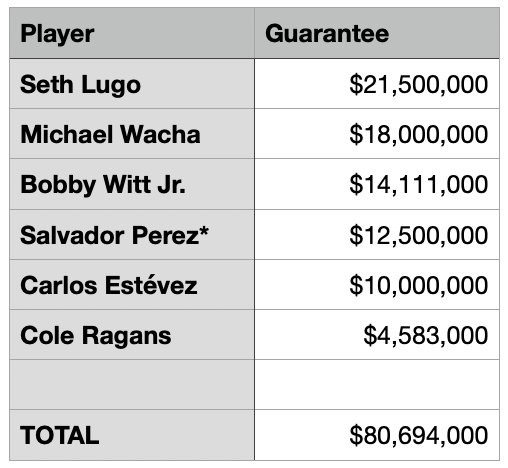
That comes to $80,694,000 for six contracts. For a little perspective, in 2021, the Royals’ Opening Day payroll was just a touch under $89 million. For the entire roster.
Wacha is in the second year of a three-year deal he signed before free agency started last winter. Lugo’s contract extension he signed last July, kicks in. Then, there’s Witt and his contract, which is going to continue to increase for the next several seasons.
Ragans is in the middle of a three-year extension he signed at the start of Spring Training last year. This would’ve been his first year of being eligible for arbitration.
I dropped an asterisk next to Perez’s name because that’s based on the information we currently have. As I noted on Wednesday, it’s possible that number drops a bit once deferrals are factored in. For now, I’ll just take that $25 million figure—which includes a $7 million signing bonus—and split it in half and use the AAV. It is probably useful to note that in his previous contract, Perez accepted around $2 million in deferred money that will be paid out on June 30, 2027.
The Arbitration Eligibles
This is a long list. Buckle up. The salary numbers are estimates that were released last month at the indispensable MLB Trade Rumors.
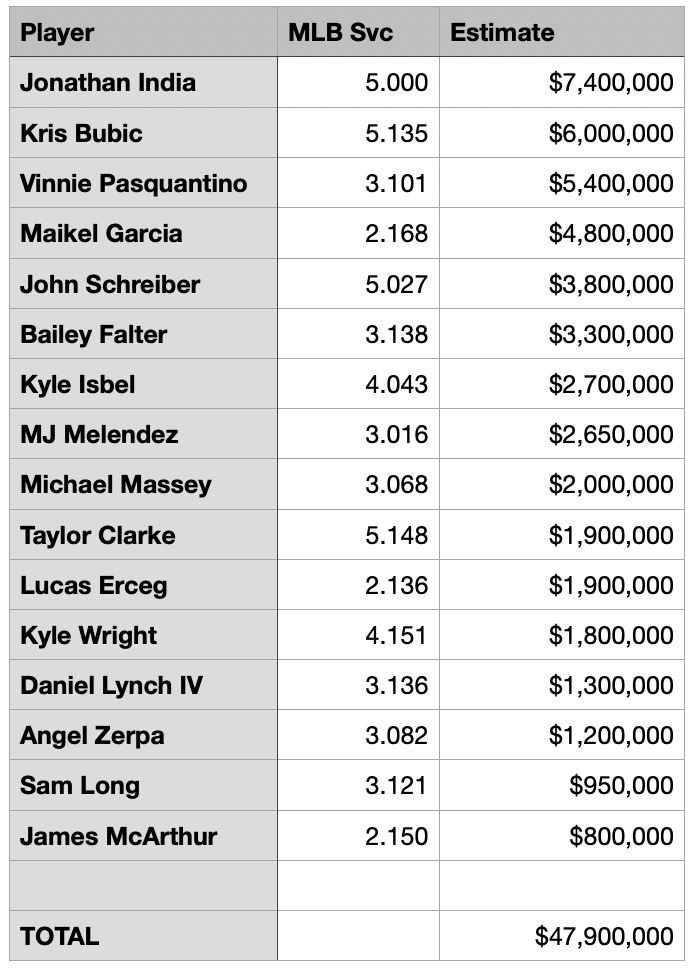
I included major league service time in the table because, in the arbitration process, that matters. It’s one reason why Jonathan India is set to make more than anyone on this list, even though Vinnie Pasquantino and Maikel Garcia were much more productive players in 2025 and figure to continue to outperform India going forward.
Of course, these estimates are if the Royals decide to formally tender a contract. Should they decide not to offer a contract, that player would become a free agent. (Which is basically what happened to Kyle Wright this week as the Royals placed him on waivers to remove him from the 40-man roster. Unless they bring him back, they will not pay him a dime in 2026. I left him on the list just to account for everyone.) Just looking at this rather lengthy list, there are several other non-tender candidates.
The most obvious one is MJ Melendez. There’s absolutely zero justification in bringing him back. If the Royals do tender him a contract for 2026, I pledge to move out of New York. After Melendez, I think decisions have to be made on Taylor Clarke, Sam Long and James McArthur. You could probably drop Daniel Lynch IV on that list as well. All four are what I would consider fungible bullpen arms, easily replaced. McArthur, like Wright, also battled injury for pretty much the entire season.
For the purposes of this exercise, let’s add up the guys we’re certain will be tendered contracts. That’s Pasquantino, Garcia, India (yes, the Royals will be bringing him back), Kris Bubic, John Schreiber, Kyle Isbel, Bailey Falter, Angel Zerpa, Michael Massey. I’m not including Lucas Erceg because the most recent indications are that he will fall just short of Super Two status, meaning he will not be arbitration-eligible for the first time in his career. Those nine estimated contracts total up to $36,600,000.
Of course, some of those guys could be inked to a contract extension. That would change the calculus. The obvious candidates would be Pasquantino and Garcia. They could take a lower amount of cash for 2026 in exchange for a year or two extra of guaranteed money.
Meanwhile, let’s assume the Royals pick up the contracts of two of the pitchers I mentioned as borderline candidates to return. That would bump the salary up around $3 million. Because I’m in love with tidy, round numbers, let’s pencil in $40 million for the Royals to settle their arbitration-eligible guys.
Combined with the contracts already guaranteed, that puts the 2026 payroll at just above $120 million for 19 players.
The Club Control Players
From the latest collective bargaining agreement that expires after next season, the major league minimum salary for 2026 will be $780,000. That’s for players with less than three years of service time who do not qualify for arbitration as Super Two players. In other words, along with Erceg, pitchers like Ryan Bergert and Stephen Kolek or position players like Jac Caglianone and Carter Jensen make the club out of spring training, and they will be earning $780,000 or very close to that amount. There are still seven players the Royals need to have on their 26-man roster, so let’s round up a bit and average $800,000 for those seven. That comes out to $5,600,000 for those players.
And then let’s not forget the buyout numbers for the options that were declined. Michael Lorenzen had his option declined by the club. He earned a $1.5 million buyout. Randall Grichuk will get $3 million for declining his part of a mutual option. Those numbers get folded into the 2026 Opening Day payroll.
Combining those two numbers into our total with the arbitration eligibles and the guaranteed contracts, the Royals current payroll comes in at just under $130 million. I am aware FanGraphs has the Royals estimated 2026 payroll currently at $140 million, but they are allocating $11 million for the club-controlled contracts, which is much too high.
The Bottom Line
The Royals leadership has been coy about a payroll target for next season. General Manager JJ Picollo said in his end-of-the-season press conference that they’re happy with where they are operating and that the team is “in a good spot.” Chairman John Sherman used the exact same phrasing when talking to Anne Rogers last month. I suppose that’s the smart play. If they gave a real number, guys like me would be writing about it all winter. It becomes a target and that’s not the way the Royals should be operating.
Cot’s Contracts has the Royals final 2025 payroll number at just under $138 million. If that’s the “good spot,” then the Royals would seem to have around $8 to $10 million rattling around the vaults to make a move. If you’ve been paying attention to the free agent contract estimates that drop this time of year from FanGraphs and the like, you know that’s not nearly enough to bring in an impact-type player. You might be able to get a reliever like Kyle Finnegan or Luke Weaver or Caleb Ferguson. The position players are largely priced out at that level. Maybe they can stretch the budget a tad and find room for Ha-Seong Kim or Harrison Bader or Gleyber Torres. Otherwise, you’re looking at bringing back a Mike Yastrezmski.
If there’s one thing we’ve seen from the way Picollo and Sherman operate, the early payroll estimates don’t mean much. If they decide there’s a player on the market who fits on the team without blowing the budget all the way out of the water, they’ll make that deal. We saw that with Carlos Estévez last winter when he was signed in late January.
While the Royals may look to lack a ton of payroll flexibility, the front office understands the stakes are as high as they’ve been in the last 10 years. They cannot afford to miss out on another postseason like they did in 2025. Not with an uncertain future on their stadium plans and while possessing a generational talent like Witt on their roster. If the window of contention isn’t currently open, they need to find a way to smash through it to build a competitive ballclub. Time, and money, are at a premium.

Comments ()