Another wasted opportunity
The Royals failure to capitalize on a potential big inning has inspired the creation of the Zumwalt Number.

The Royals lost on Monday. Again. To the New York Yankees. Again. In particularly excruciating fashion. Again.
At some point, the gut-punch losses all meld together into some sort of devastating uppercut—just one hammer blow to put us all out of our collective misery. Sunday's game was there for the taking for the Royals. Just enough offense, another stellar outing from starter Michael Wacha and, what you would hope to be a solid turn from the bullpen could've brought home the win. Instead, it's a 4-3 loss. Another blow in a season that has been disappointing and underwhelming. Contenders win these kind of games.
Ahead of the game, there was some question as to the availability of closer Lucas Erceg. The day prior, Erceg stumbled through the ninth inning in the series finale against the Seattle Mariners. Since the Royals have been losing on the regular, there hasn’t been much need for a closer. Sunday was the first appearance Erceg made on the homestand. He last pitched a week ago in St. Louis.
Whether it was rust or the lack of adrenaline because it wasn’t a save situation or because of some other reason, Erceg was far from sharp on Sunday. He got the first batter swinging, but then the Mariners started to square him up. By the time the third out had been recorded, Erceg had thrown 32 pitches, allowed four hits and three runs. The Mariners, who had been trailing by five when the inning opened, went down with the tying run at the plate.
Hey…It’s not always about the journey. The destination matters! The Royals needed a victory and Erceg got the final three outs to nail down the win, no matter how uncomfortable that was.
Except that's not the kind of work Matt Quatraro was hoping to get from his ninth inning man. After 32 pitches and increasing stress as the baserunners accumulated, there were questions whether the Royals could count on Erceg again the next day, if needed. Wouldn’t you know it, the Royals entered the ninth with a slim 3-2 lead over the Yankees. The services of a closer were required.
While the Mariners were on Erceg the day before, Monday's outing was death by 1,000 paper cuts...Or by excruciatingly weak contact.
Paul Goldschmidt got absolutely sawed off on a 1-2 slider that he really had no business swinging at, it was so far inside. Single. Jazz Chisholm softly lined a ball just past Salvador Perez at first who was holding the pinch runner Max Schuemann on. Double. Perez had just entered the game at first, replacing the lefty, Vinnie Pasquantino. I think Pasquantino fields that ball. I also think that, had starter Jac Caglianone still been in the game in right—he was lifted for a pinch hitter in the eighth—Chisholm would not have been so bold with his baserunning. Now, the Yankees had runners on second and third with one out.
Next up, Anthony Volpe. Volpe, the Yankees primary shortstop the previous three seasons has a career .222/.285/.378, good for a 83 OPS+. He missed the start of the season recovering from shoulder surgery he had back in October. Still, when his rehab time was complete, the Yankees optioned him to Triple-A. He was recalled a little over a week ago. Down 1-2, Erceg delivered a slider that didn’t slide enough. It hung in the lower part of the zone, allowing Volpe to get his bat to it and flick it over the drawn-in infield for a single. Both runners scored. Three batters. Two runs. Just like that, the Yankees flipped the script. Although since this was the Royals and the Yankees, maybe this was the script all along.
While the Mariners were on Erceg in his Sunday outing, the Yankees benefitted more from a bizarre alignment of the stars, a moon and probably some random planets and other pieces of space junk. This was the contact that was made against Erceg in the ninth inning.
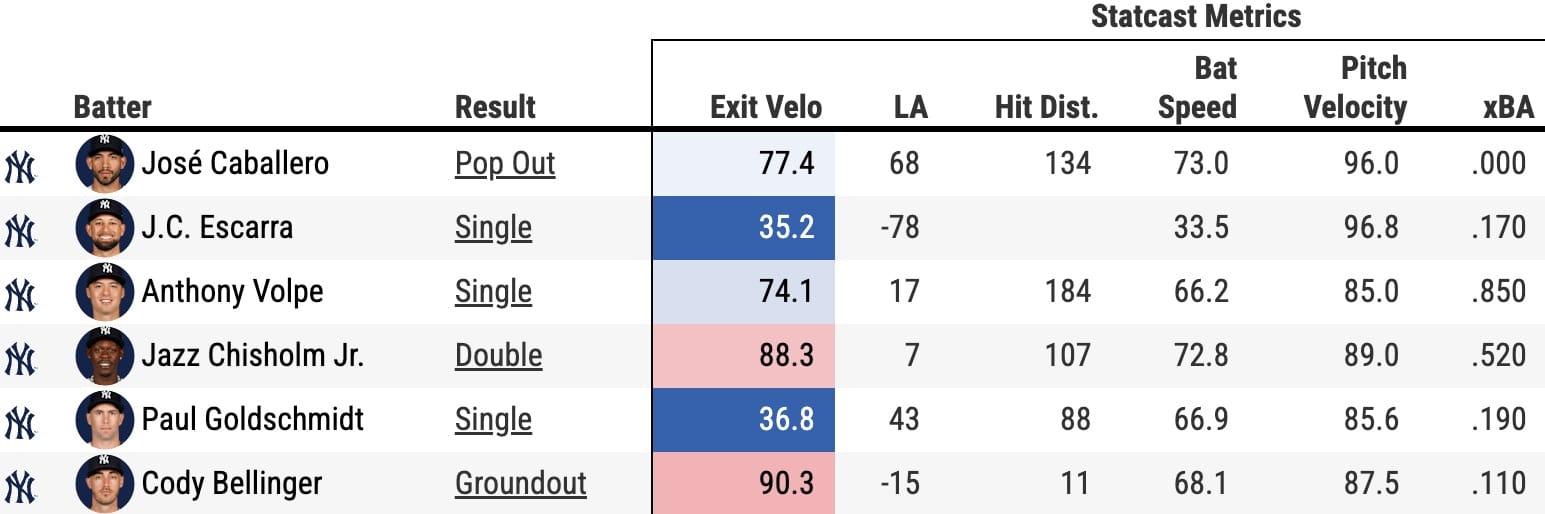
It's from Baseball Savant, so work from the bottom up. The hardest hit ball in the inning was the first one, a ground out from Cody Bellinger. From there, it's weak to moderate contact with the Chisholm and Volpe hits coming on solid launch angles that allow the expected batting averages to be strong. The Volpe hit, in particular, was just some exceptional situational hitting. And the death blow.
Yeah, things like this happen. Why does it have to happen against the Yankees?

The Royals scored their three runs in three separate innings. The first run came after the Royals drew three walks in the first four batters in the second inning, loading the bases. Nothing will get you salivating for runs like three walks in an inning. It’s a time when maximum damage feels like the most likely outcome.
For the Royals, maximum damage comes from tallying just a single run in that situation.
It’s unreal. A friend of mine on Bluesky posted this to Royals Review a few days ago:

I have thought of this often since he posted. It's perfect.
On Monday, I did a little digging. Years ago, Joe Sheehan at Baseball Prospectus coined a gimmick stat he called the Guillen Number. (Calling it a "gimmick stat" is complimentary.) Named in honor of former White Sox manager Ozzie Guillen, it’s the percentage of runs a team scores via the home run. It is supposed to illustrate which offenses are a bit more singular in how they score runs in an outsize dependance on the home run. In a similar spirit, I would like to propose a new gimmick stat: The Zumwalt Number.
Named after Royals hitting coach Alec Zumwalt, the Zumwalt Number shall be the percentage of the total number of runs a team scores when making an out. A team that consistently turns those three-run innings into one-run innings. This certainly seems to be the hallmark of the Zumwalt era.
Using Baseball Savant, I ran a query of runs scored when teams hit into outs or a fielder’s choice where no outs were recorded. Basically, it's any time a run scores when the ball is put into play and an out is made—or should’ve been made. It’s a work in progress, but I think it could evolve into something.
A fantastic example: The Royals were at their Zumwalt Number best in their victory on Saturday against the Mariners. They scored five times, with three of those runs coming across when an out or fielder’s choice was made.
Vinnie Pasquantino fielder’s choice.
Carter Jensen ground out.
Jac Caglianone single.
Carter Jensen sacrifice fly.
Isaac Collins single.
When you fall into a Baseball Savant worm hole, you learn marvelous things. Did you know that in addition to his four sacrifice flies this year, Pasquantino has driven in three runs on fielder’s choice plays where he was safe at first? It will not shock you to learn he's the leader in this wonderfully random and meaningless category.
Anyhoo…Let’s get back to this new gimmick stat known as the Zumwalt Number. Here is the leaderboard on teams that have scored the highest percentage of their runs while making an out or a fielder's choice where the batter was safe:
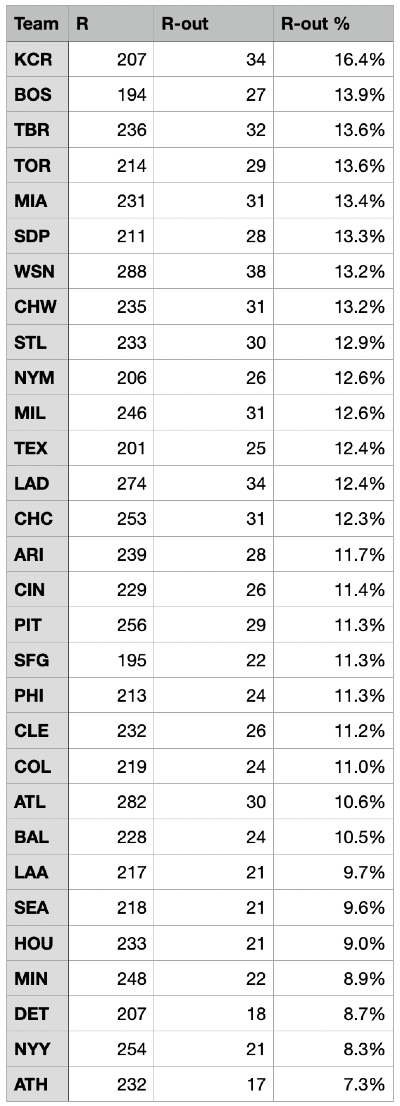
Where "R" is total runs scored, "R-out" is runs scored via recording an out and "R-out %" is the percentage of all runs scored while making an out. The numbers in the table above are through Sunday's games. By scoring one of their three runs while making an out—Michael Massey drove in the first run of the day after those three walks with a sacrifice fly—their Zumwalt Number will increase.
Not only are the Royals the leaders in the percentage of their runs coming across while making an out, they are well ahead of the field with a margin of 2.5 percentage points over the second place Boston Red Sox. The next largest gap between any two teams comes at the bottom of the table where the Athletics are a full percentage point behind the Yankees. It's a massive gap the Royals have over the rest of the league. Most teams are in the neighborhood of the league average of 11.6 percent. All hail the Zumwalt Number leaders!
Sure, it's a gimmick, but why should we care about a Zumwalt Number? I think it's because as I stated above, it underscores offensive futility. We know outs are precious commodities, not to be wasted. When a team has the bases loaded with one out and can only muster a single run while coming on an out, that has to go down as a missed opportunity...offensive futility in a nutshell. A hit scoring a single run in that situation continues to put pressure on the pitcher and the defense. They are still far from an escape. Score a run while making an out and the team on the field just needs one more out to get out of a potential jam. The Royals were down by two at that point on Monday. They needed to get back into the game. The run allowed them that chance. Yet I'll argue it's better to chip away while keeping the line moving than hitting sac flies and fielder's choice ground balls. Think of how different the inning could've been had Massey hit a single to move all runners up just 90 feet. You have a pitcher on the ropes and an offense ready to go off. Instead, the sac fly allowed Will Warren a moment to get right. He ended up working six innings on Monday.
Of course, I'm not arguing that the Zumwalt Number is entirely derogatory. Nor is it some sort of philosophy a hitting coach would preach. Of course, runs are always important. Sometimes, the lone run is the optimal outcome. However, that was not the case in the second inning on Monday.
The Run Expectancy Matrix—the number of runs a typical team will score given the number of outs and position of baserunners—varies from season to season. A current-ish version can be found at FanGraphs. Scanning the tables, we see that in the position the Royals had in the second inning on Monday—bases loaded and one out—the typical offense will plate around 1.6 runs. Of course, you can't score 0.6 runs but I think it's safe to say that two runs at a minimum needs to come across when a team finds itself in that situation. The Royals scored one, while making an out. Not good enough. Which is the way we can describe the Royals offense in 2026...Not good enough.
My argument—based on nothing more than my gut at this point—is that a team that has an above the league average percentage of the Zumwalt Number is not generally a productive offense. Indeed, of the top ten teams on the table above, only the Tampa Bay Rays (+40) and the San Diego Padres (+6) possess a positive run differential. I believe this is because when a team is scoring a higher than average percentage of their runs while making outs, they're often sacrificing the potential for a larger bounty. Fewer crooked numbers on the scoreboard. Again, as the Bluesky statement read from my friend, the Royals frequently turn three-run innings into one-run innings. That was what happened in the second inning on Monday.

The Royals other two runs on Monday came via solo home runs. Salvador Perez tied the game in the sixth and Bobby Witt Jr. broke the tie with a bomb in the eighth.
If you are interested in the Royals Guillen Number, entering play on Monday it was at 33.8 percent, good for 22nd in the majors. The Seattle Mariners are the Guillen Number pacesetters at 46.6 percent. There is a much broader range in the Guillen Number than the Zumwalt Number.

Witt did not hit his first double until the 12th game of the season. He was without a home run until game 28. After a slower than anyone would've liked start to the 2026 season, Witt is turning in another year for the ages. He currently leads all of baseball with a 3.3 fWAR. When he hit that go-ahead home run in the eighth, it just felt like typical Bobby Witt, Jr. The kid is so good at this. We are lucky to have him in Kansas City.
It is simply unbearable to think that the Royals will continue to waste the prime years of Witt's talent.
Comments ()