Coming up short
The Royals dropped the series to the Brewers, but showed the gap between the two teams is closer than you may think.
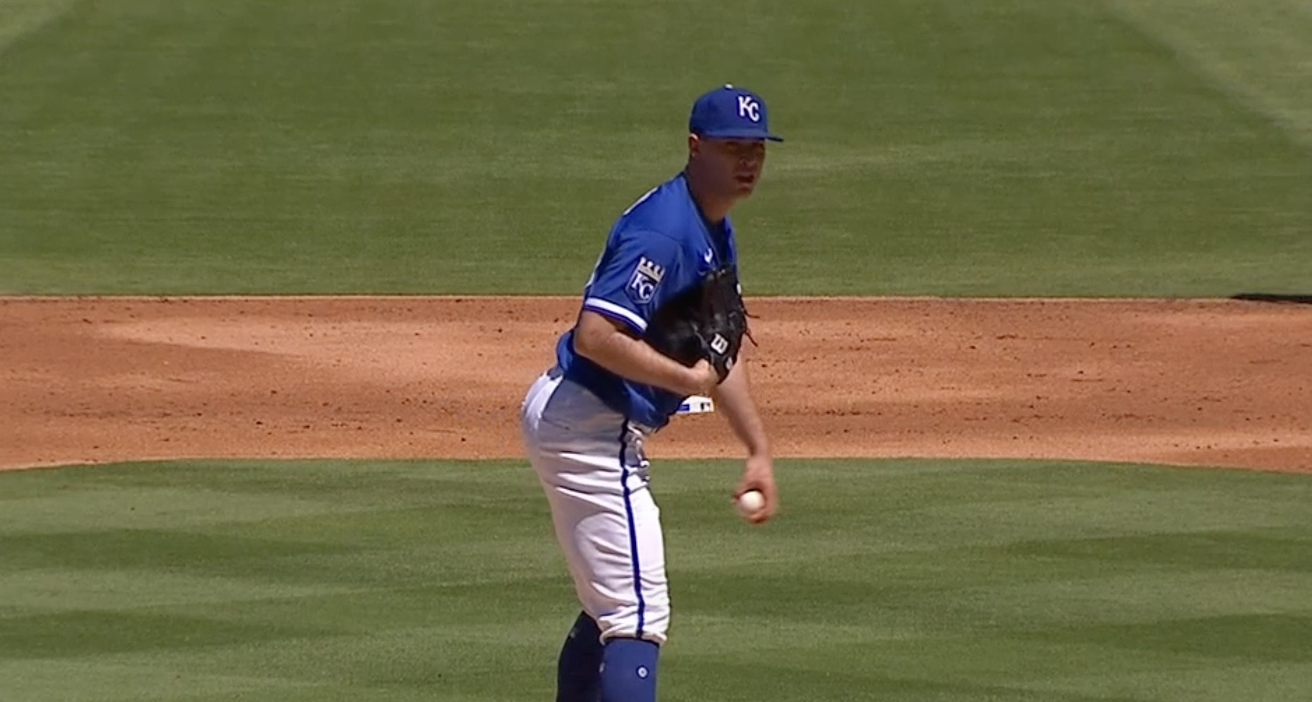
The Royals lost the game—and the series—to the Milwaukee Brewers on Sunday, dropping the finale by a score of 8-5. To their credit, the Royals battled on Sunday afternoon and hung with the Brewers for the entire series.
Despite losing two of three, the Royals felt up for the challenge. In the three game set, both teams tallied 15 runs. The Royals had 27 hits to the Brewers 25. The Brewers had nine hits with runners in scoring position. The Royals had 10.
The numbers say this series was as even as a three-game set could be. The vibes say something a bit different. This is a relentless Brewers team. They battle and scratch and claw. The Royals battle, too. It's just that the Brewers know how to push across the finish line.
Even this early in the season, this series felt like a good measuring stick. The Brewers are who the Royals hope to become—a small market team that's a perennial competitor. The Royals aren't there...yet. But they're improving. There's reason for optimism in these games. They need to improve those little things between the margins that often prove decisive. The Royals were undone by a litany of the small things on Sunday.

Last year, Sunday's starter Kris Bubic threw his four-seam roughly 36 percent of the time. Out of his arsenal of five different offerings, it was his most frequently utilized pitch. The first time through the order on Sunday against the Brewers, Bubic leaned on his four-seamer a whopping 68 percent of the time.
This is how his pitch chart in the first inning looked. Of the 28 pitches he delivered, 21 were of the four-seam variety.
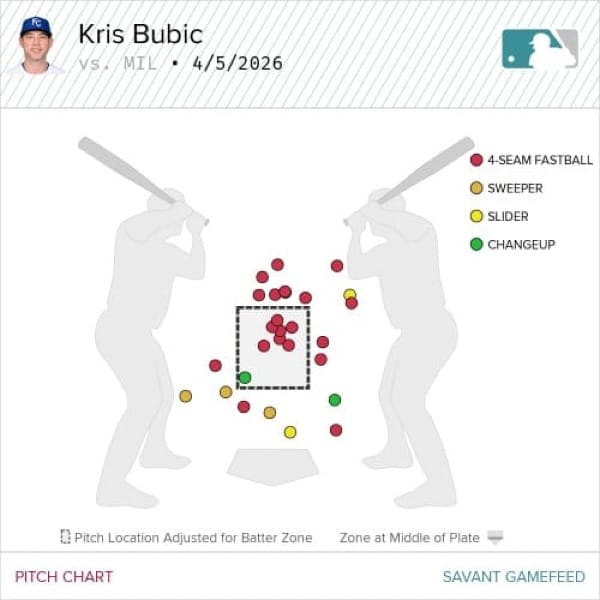
Bubic is at his most effective when working up in the zone with his four-seamer. The cluster in the middle of the zone is only slightly alarming because Bubic was pitching behind the count for most of that inning. Those are tasty fastballs for hitters. They were necessary for Bubic to find his footing.
He opened the day throwing five fastballs in six pitches to left-handed hitting Brice Turang.
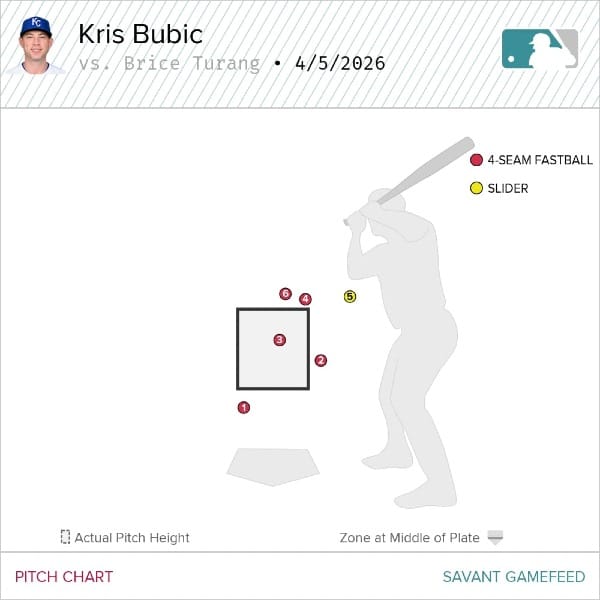
Bubic fell behind 2-0, went with a pipe shot to get back in the count, then worked up in the zone. The Bubic fastball has that spin that gives it a rising illusion. I think it looks like it explodes when it reaches the plate. Like it’s traveling on a lower plane and then hits an invisible speed bump, launching the baseball onto another plane altogether. That doesn't actually happen, but the spin makes it appear so. Frequently, the elevated Bubic fastball results in a swing and miss. In this instance, Turang made contact but it was late and he was under it.
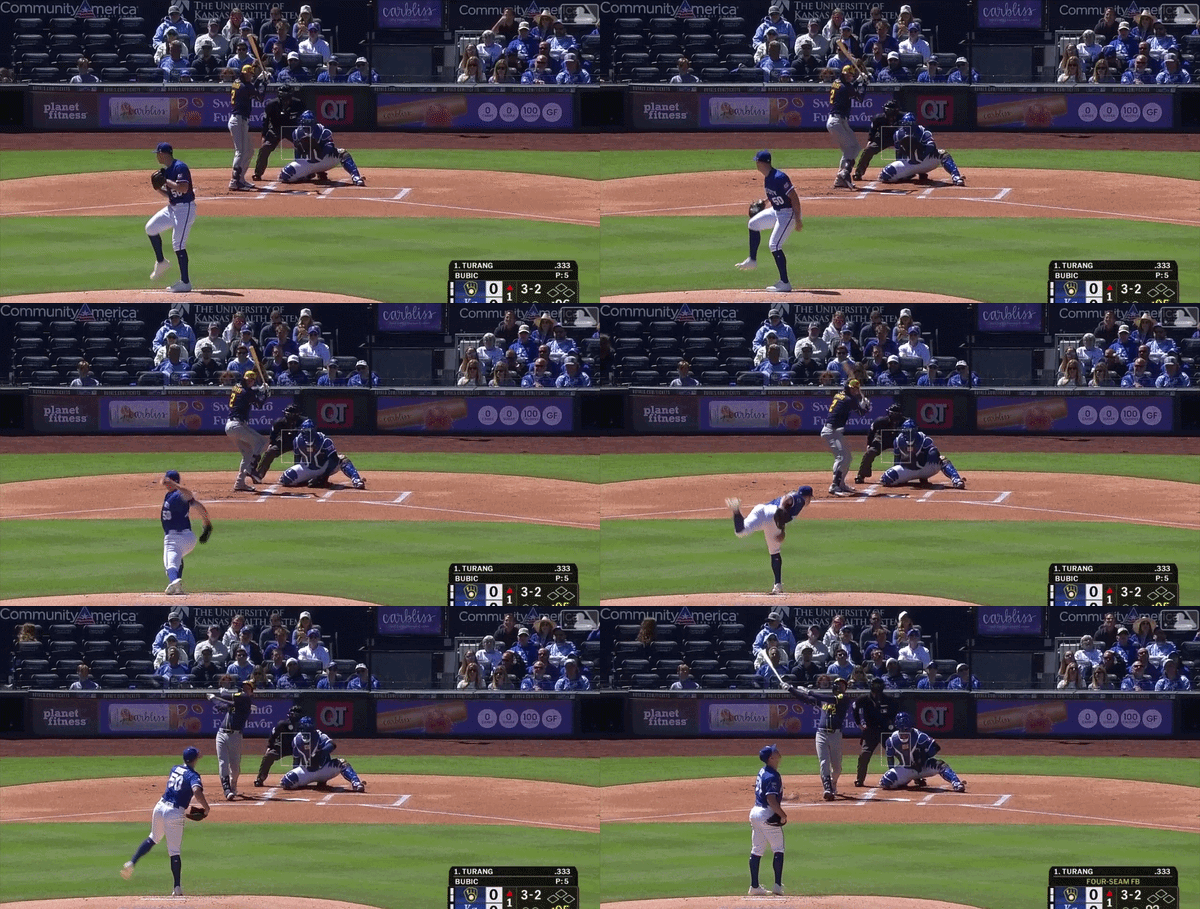
The result was a lazy fly to left.
Bubic needed only two pitches to get the second out of the inning. Starting Luis Rengifo with a get-ahead-in-the-count fastball before dropping down and out of the zone with a sweeper.
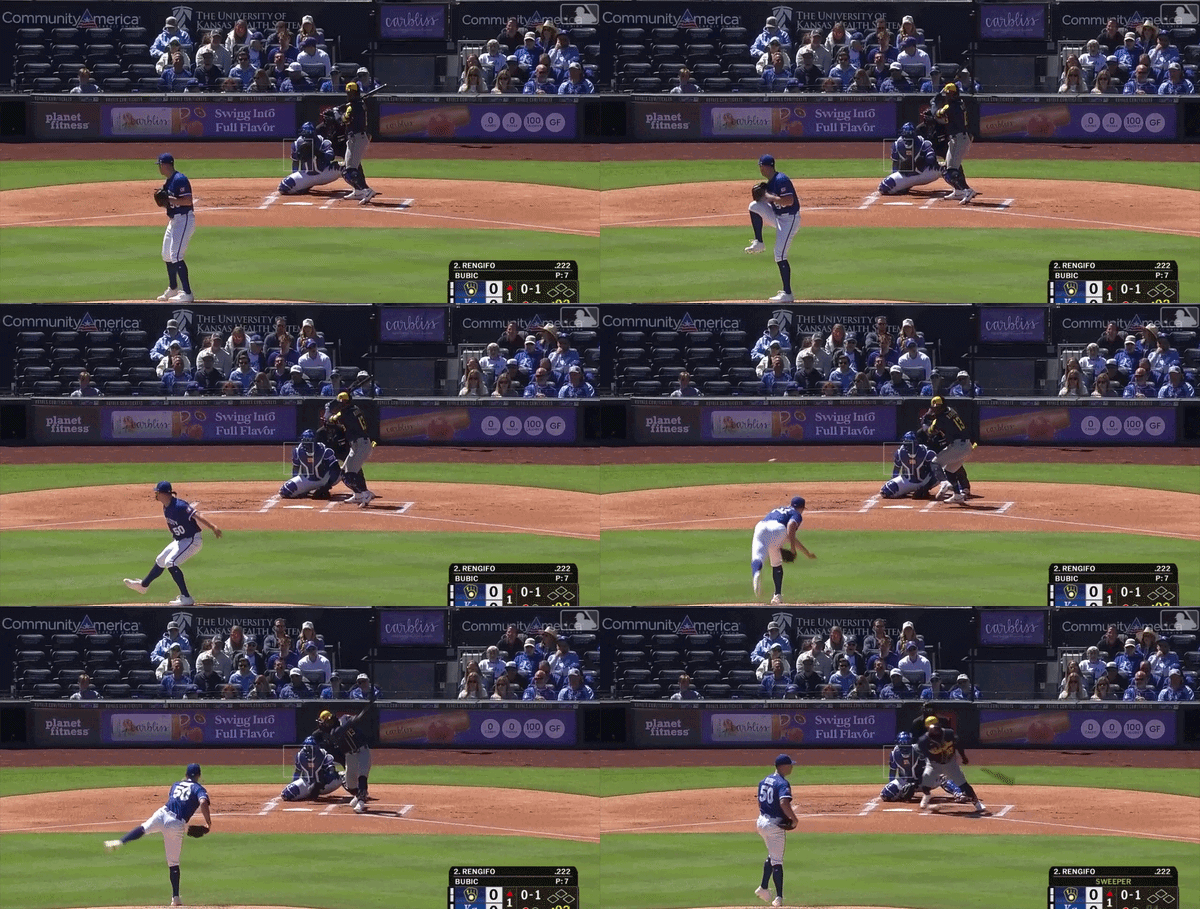
I'm not sure Bubic could've asked for a better first two batters. Fastball up on a 3-2 count that results in a chase and a fly ball out, followed by sweeper down on an 0-1 count and another chase and an easy ground out.
Except then Bubic started missing with his four-seamer. By a lot.
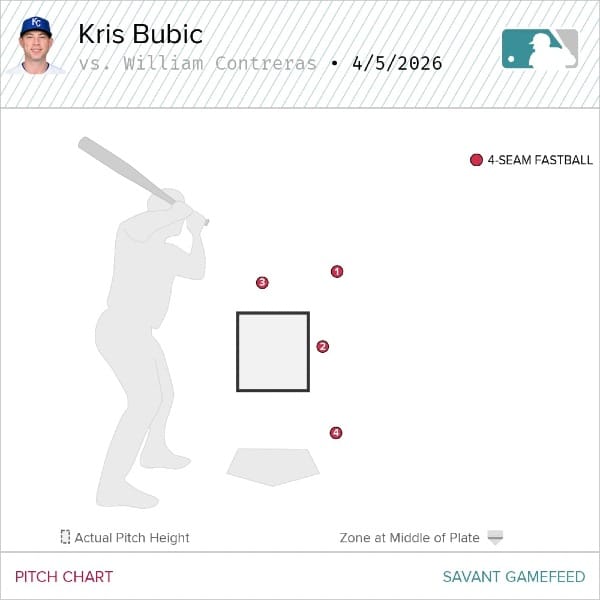
The above confrontation with the dangerous William Contreras was uncompetitive. Next up was Christian Yelich. Bubic fell behind 3-0 with two fastballs and a sweeper. The chart below illustrates the location of the first three pitches Bubic threw to Yellich. Seven called balls in a row. There was more.

Bubic was clearly annoyed after he delivered that third ball out of the zone. It prompted a visit from his catcher Salvador Perez.
I’m not sure what was said and I’m not certain that it helped because Bubic just sort of started rearing back and letting it rip. Three consecutive fastballs, all in the same general vicinity slightly up and mostly down the chute.

Yellich didn’t barrel the third fastball in the zone and was actually behind the pitch. He lofted it down the line and ultimately, just out of the reach of Nick Loftin, playing in left. A tough play for Loftin. Buzzard luck for Bubic. The Yellich batted ball had an expected batting average of just .100. Instead, it went for a run-scoring, two-out triple. The Royals were behind 1-0 just four batters into the game.
Next up was Gary Sánchez. Once upon a time, Sánchez obliterated fastballs. In his first season in the majors, he his .314 with a mega .704 slugging percentage against fastballs. In his second season, in 2017, he continued his success hitting .270 against the heater with a .540 slugging percentage. He’s 33 now and doesn’t have that kind of success against the fastball anymore, but it’s still the pitch he does the most damage on. Bubic, after starting Sanchez with four-seamer, momentarily moved away from the heat. Sánchez decided to be a pedestrian and simply watch.
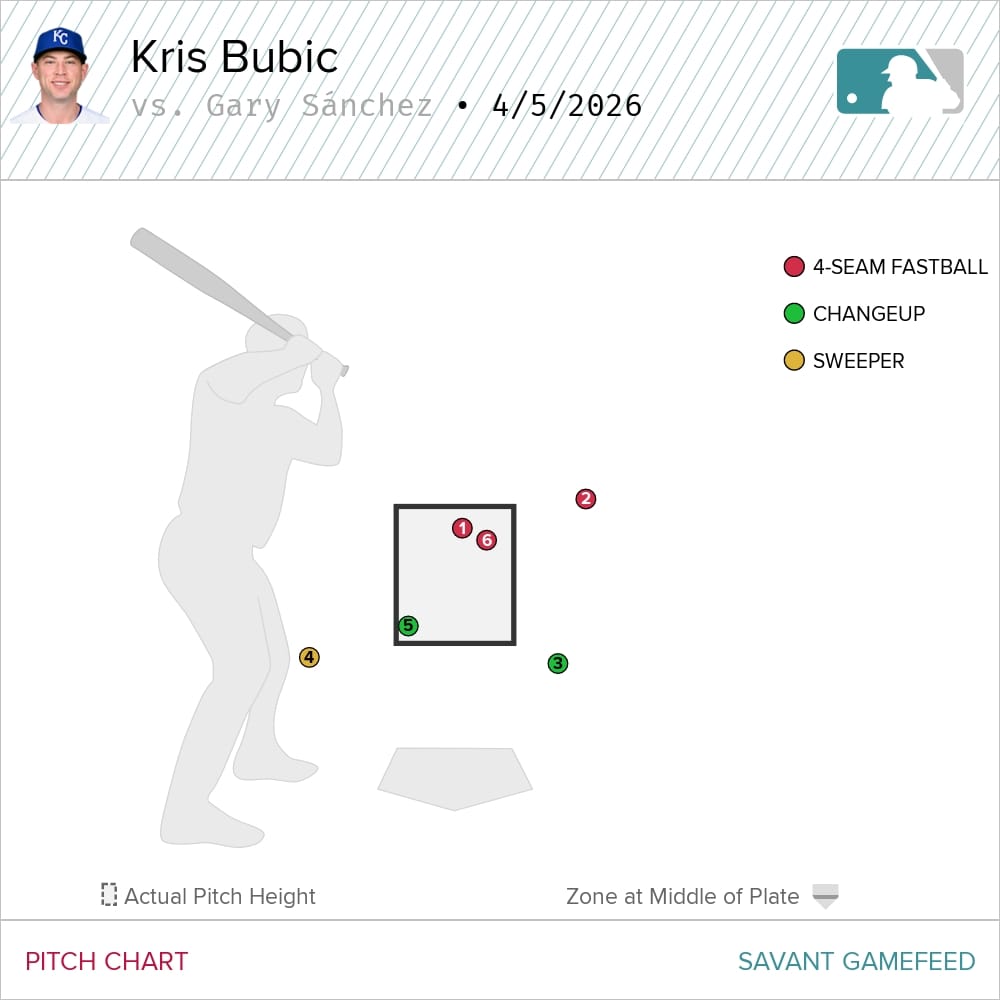
Sánchez didn’t move his bat on any of the first five offerings from Bubic. Can’t blame him as again Bubic was uncompetitive with his offerings once he jumped ahead with that first-pitch fastball. Bubic came back with a 3-1 change that was perfect in execution. It had both location and the element of surprise. It was a nifty pitch.
With the count full, a runner on third and two out, Bubic went back to his fastball. A challenge pitch. Sánchez was up for the challenge. Goodbye, baseball. The Brewers led 3-0 before the Royals came to bat.
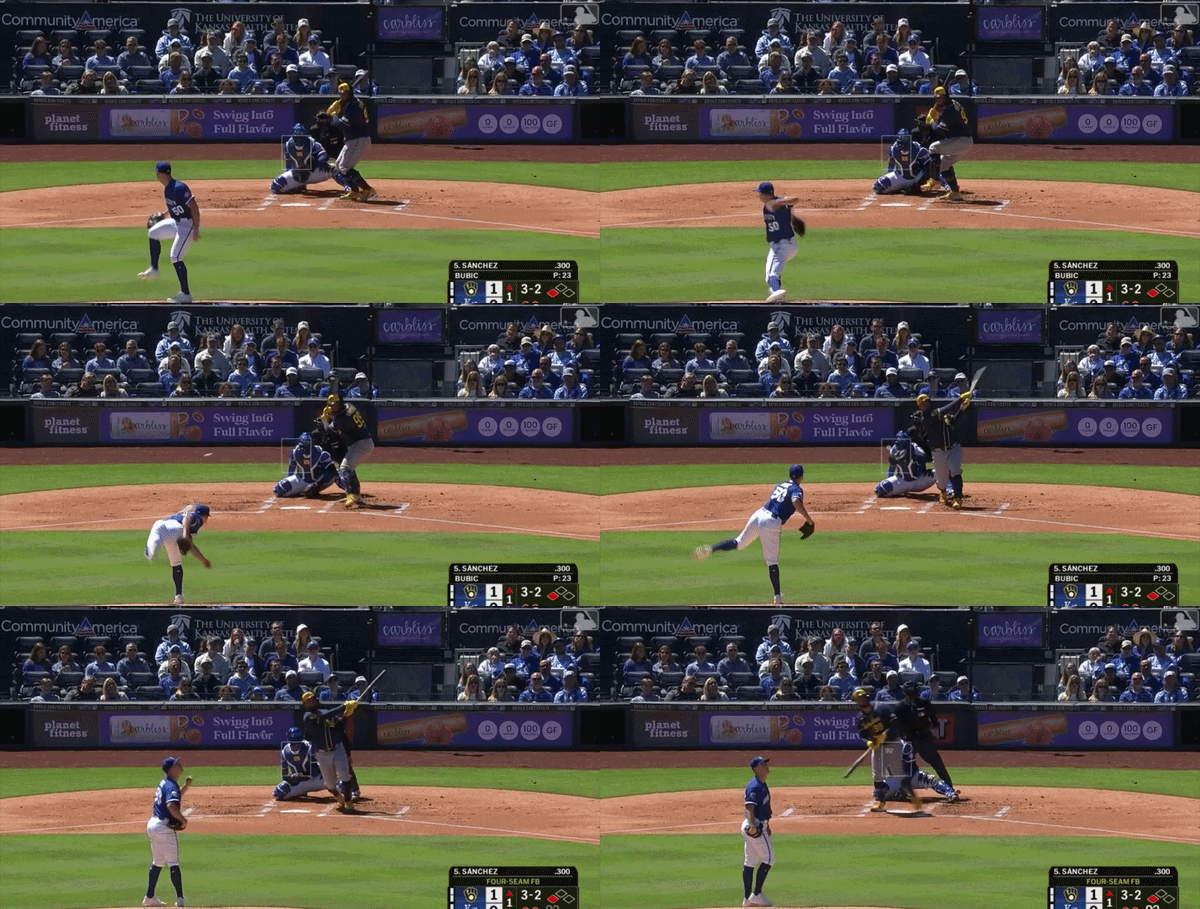
Bubic would give up another run in the fourth inning. Like those in the first, it all came together with two outs. Again, like the first inning, it began with a walk.
If anything, this run was more frustrating than the bunch that crossed the plate in the first. Bubic had been cruising, retiring nine of the previous 10 batters he faced—seven of them via a swinging strikeout. He had shifted from frustration to dominance.
This was how his battle unfolded against Brandon Lockridge.
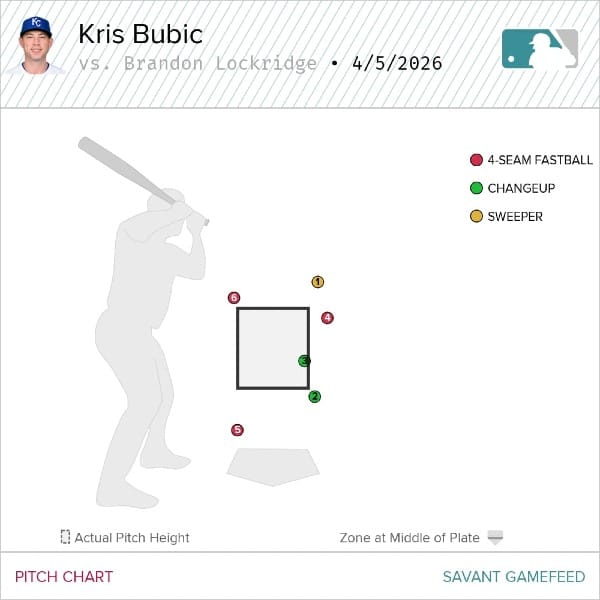
After uncorking a sweeper well up and away, Bubic went to back-to-back changeups to jump ahead. Pitch two, down and away, was offered at by Lockridge and missed. Pitch three, nestled on the outer edge of the plate, was fouled off. From 1-2 though, Bubic went to the four-seam well for the next three pitches. He missed badly with all three and Lockridge walked.
The next batter was Blake Perkins. He spit on a first-pitch four-seamer down and well out of the zone. The next pitch was another fastball. This one was begging to be tattooed.
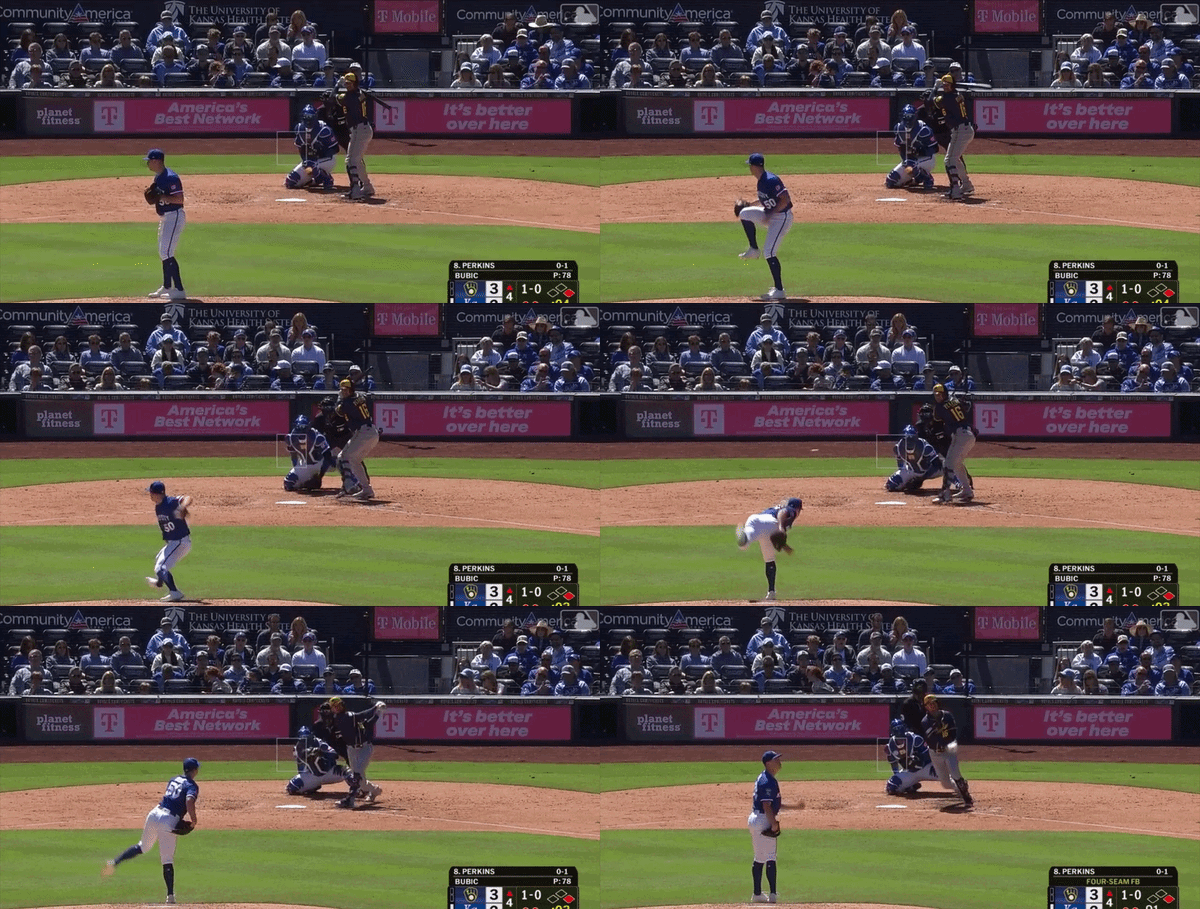
That was it…in two separate, yet incredibly similar moments, Bubic was undone, betrayed initially by command of the four-seam and then with the ultimate destruction coming from when he attempted to correct and ended up serving a couple of meatballs on a plate.
It’s a shame that Bubic battled those two separate lapses in command because he was otherwise dominant. There were those seven strikeouts between those runs with another to close out that fourth inning. He finished his start with a 41 percent whiff rate on his fastball, along with a chase rate of 38 percent on the pitch. When that pitch is on and exploding beyond the upper reaches of the zone, it’s absolute in its unhittableness. (I don’t think “unhittableness” is a word, but it sounds kind of cool and I’m between editors at the moment.) He had a total of 18 whiffs in just five innings of work.
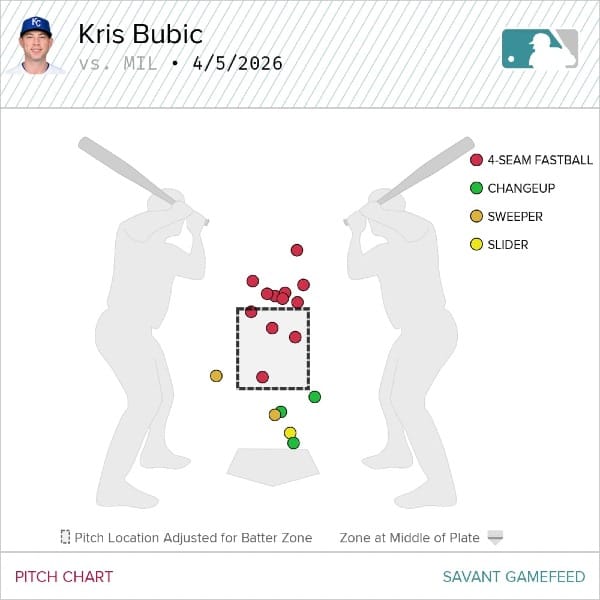
Look at the whiffs he generated on the fastball above the zone. That's what happens when your four-seam explodes like it seems to do when Bubic is at his best. And there were times on Sunday, even though it won't look like it in the box score, he was at his best.
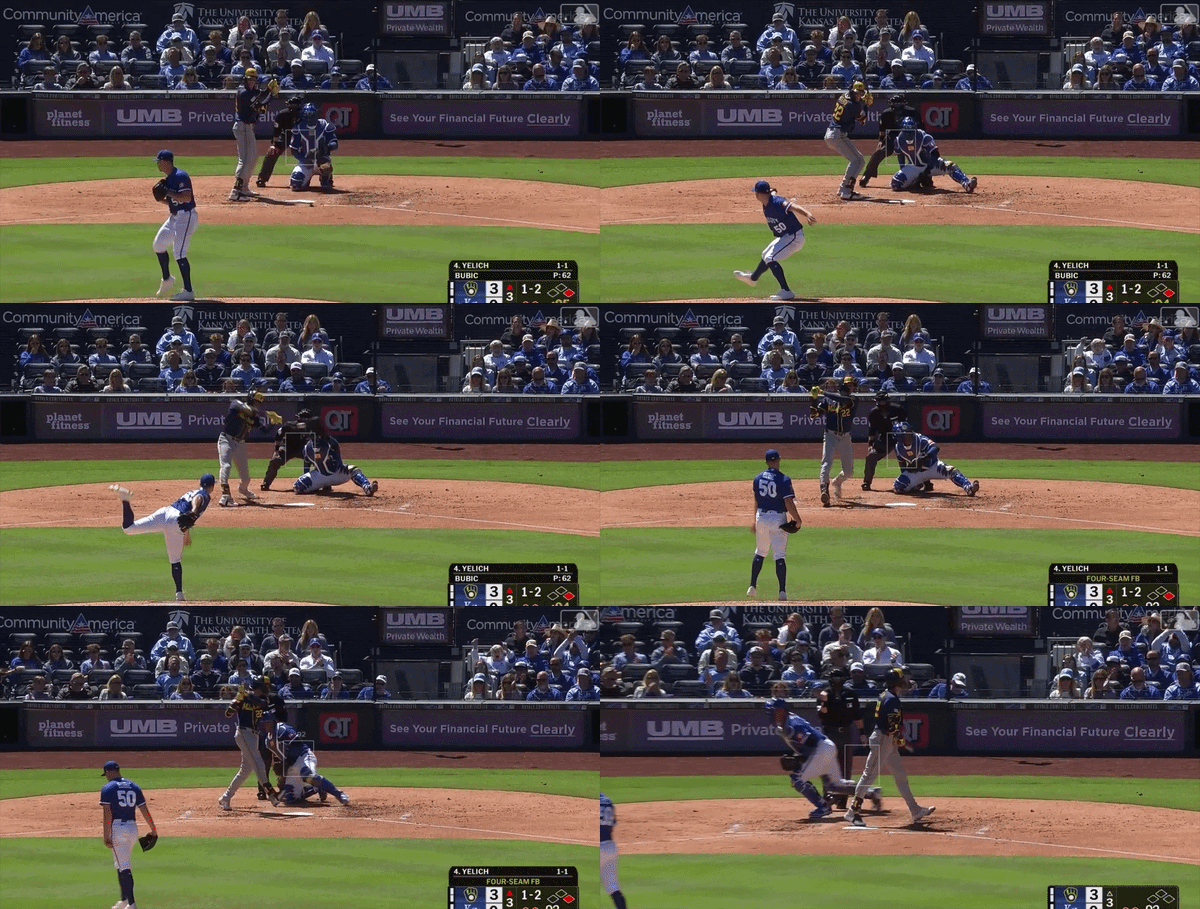
Nasty.
I should also note he served up a strike on 63 percent of his fastballs thrown on Sunday. Still undone by those pitches that were so far out of the zone sort of came in bunches and were relatively easy takes for the hitters.
It made for an uneven and frustrating afternoon. While there was plenty of good stuff to counterbalance the bad, sometimes the bad comes out on top.

Here’s a fun one…Entering Sunday’s game against the Brewers, the Royals bottom third of the order was hitting a collective .313/.396/.513 through the first eight games of the season. That worked out to a 170 OPS+, meaning that the seven, eight and nine hitters were 70 percent better than the league average at the bottom of the lineup card.
Kyle Isbel had the day off on Sunday and I was actually perturbed by that.
Despite the absence of Isbel, the Royals bats did show a bit of fight on Sunday. They could just never draw even in their battle. A Jonathan India walk in the third was followed by a Maikel Garcia bomb. Garcia has not missed a beat from his MVP turn in the World Baseball Classic. The Royals kept the heat on when Bobby Witt Jr. walked and swiped second. Vinnie Pasquantino lined a single to right and Witt tried to score, but was gunned down at home.
On one hand, there was just one out at the time so they could’ve played it safe and held Witt at third. Plus, the ball Pasquantino hit was a hard liner and Witt didn’t get the best jump. On the other hand, it’s Bobby Freakin’ Witt Jr. running the bases. That alone puts a bit of pressure on the outfielder. Credit Luis Matos for a perfect throw home. Witt made it closer than it should’ve been.
The bottom of the order started a seventh inning rally that again saw the Royals creep to within a run. Seventh place hitter, Starling Marte opened the inning with a single. Number eight, Jonathan India, walked. He reached base three times on Sunday with two walks and a HBP. Then Isaac Collins, pinch hitting for Nick Loftin hitting ninth, lined a single to load the bases.
After watching the bottom of the lineup last year as a black hole inside a vortex of nothingness, it’s something to see this year’s group produce like this. It’s been great that Garcia is hitting at the top of the order because he’s been cashing in on some of this action. He did so in the seventh, lining a single to drive home a run.
Then, with the bases still loaded, Witt was called out on strikes.
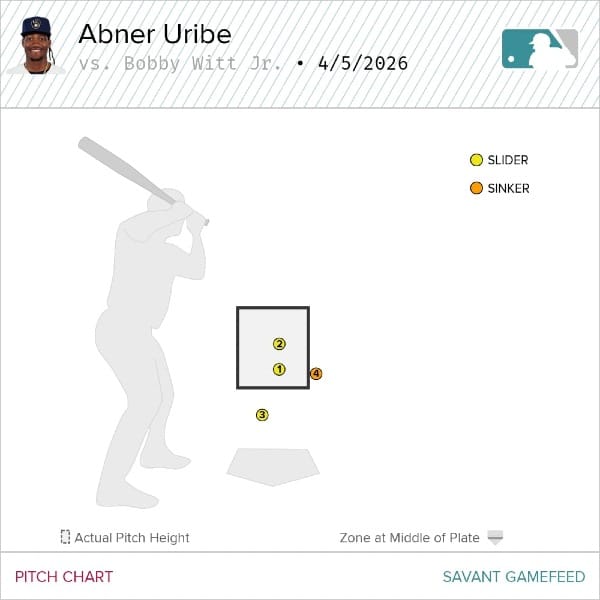
That’s the sort of pitch that needs to get challenged. In that situation (bases loaded, down by three in the later innings) there is literally nothing to lose. Alas, the Royals were out of challenges.
At least his teammate, Pasquantino, picked him up, lining a two-run single to cut the deficit to one. Like in the third, they just couldn’t figure out a way to get the tying run across.
I note the Royals closed the gap in the later innings because two things happened late in the game that just shouldn’t happen.
One, after India walked in the eighth with two outs, Tyler Tolbert was summoned to pinch-run. He was on the bases for three pitches before he was picked off to end the inning. A pinch runner getting picked off will drive me to the baseball loony bin.
Then, with the Royals still trailing by one in the ninth, Matt Quatraro brought in Lucas Erceg. The mission here was to keep the game within reach. Erceg couldn’t. He simply didn’t have his stuff, allowing back-to-back doubles, a wild pitch, a walk and a single.
Erceg’s uneven outing continues a theme from this year’s Royals bullpen: There is nobody there that Matt Quatraro can trust. Pick a reliever, any reliever…they have been excruciatingly inconsistent. With the exception of Nick Mears. We are three series into the season and someone needs to step forward and firmly plant both feet inside Q’s circle of bullpen trust. Otherwise, it’s going to be a long and very frustrating season.
Comments ()