Can Jonathan India be average?
The Royals are betting on a bounceback season from their second baseman.
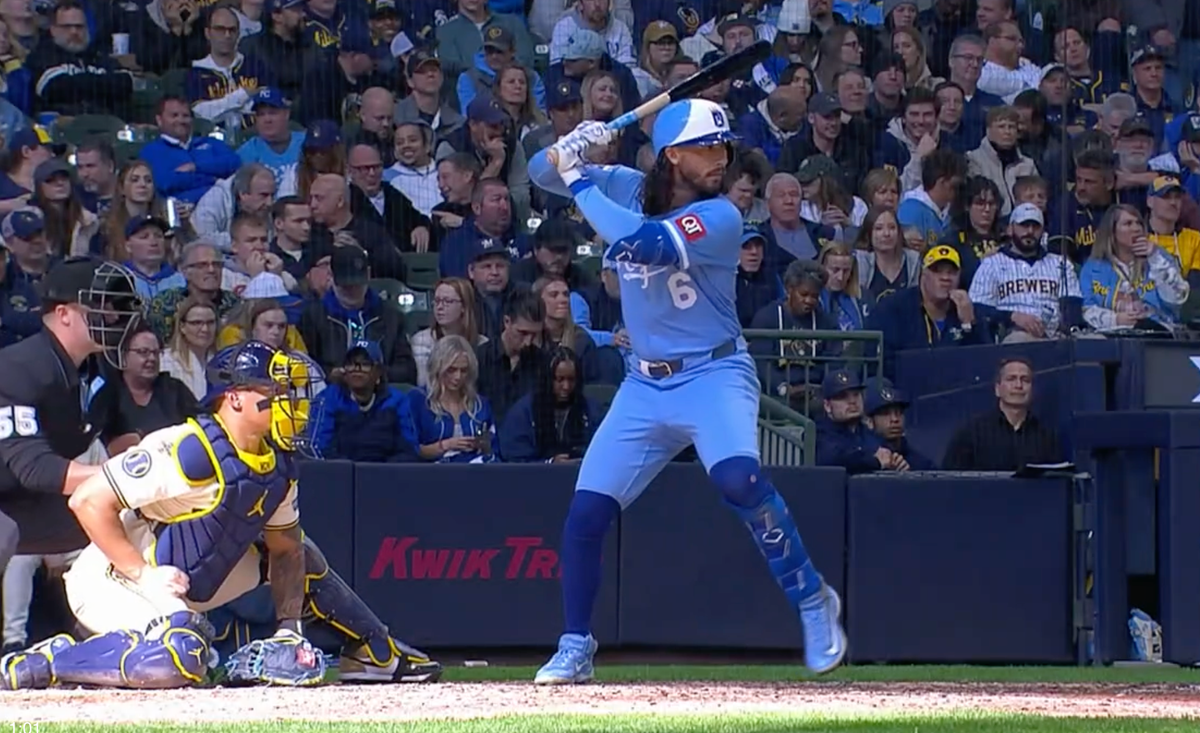
The best season on Jonathan India’s career was the first one. Back in 2021 for the Cincinnati Reds, the second baseman hit .269/.376/.459, good for a 122 wRC+ and first place in the National League Rookie of the Year balloting.
After that breakout year, India settled into something of a comfortably average output. His OBP settled in around .335 or so, which was fine. His slugging percentage dipped, though, to somewhere in the .390 range which was decidedly less fine. Overall, he was generally in the neighborhood of a 100 wRC+. Average. Or, as the kids say, mid.
There is value in being average. Especially if a ballplayer is consistently average. That way, a manager can pencil the guy into a lineup at a set position with the knowlege he’s going to produce a bit while generally not hurting the club.
While 2021 represented the best of India, the just-completed 2025 season was his nadir. India, hitting just .233/.323/.346 with an 89 wRC+, finished with career worst rates across the board. That performance at the dish, combined with some slipshod defence in a couple of positions, meant that, for the first time in his career, India finished at a below-replacement level with -0.3 fWAR.
I’m not being negative when I write that this was a very, very poor year. It’s fact. Certainly, it was not what JJ Picollo and the Royals envisioned when they shipped starter Brady Singer to Cincinnati last winter. In that moment, the Royals believed they found their leadoff hitter. A missing link in an offense that sputtered to the finish line before going down weakly in the ALDS. So it was a surprise when the Royals opted to tender India a contract for the 2026 season. India leapt at the opportunity (I don’t blame him at all), signing a deal worth $8 million for 2026.

Let’s discuss what India does well. The guy has elite plate discipline. When I write “elite,” that’s not hyperbole. His walk rates can reach double-digits and are always comfortably above average. Even in 2025 which was a generally dreadful season, India posted a 9.5 percent walk rate, almost a percentage point higher than the league average.
This year for the Royals, India went fishing outside the strikezone just under 19 percent of the time. That places him in the 97th percentile among qualified hitters. By comparison, Salvador Perez, who is in just the second percentile in chase rate, posted a 42 percent rate. The yin and the yang of plate discipline in one lineup.
These are the pitches outside the zone that India swung at and missed in 2025.
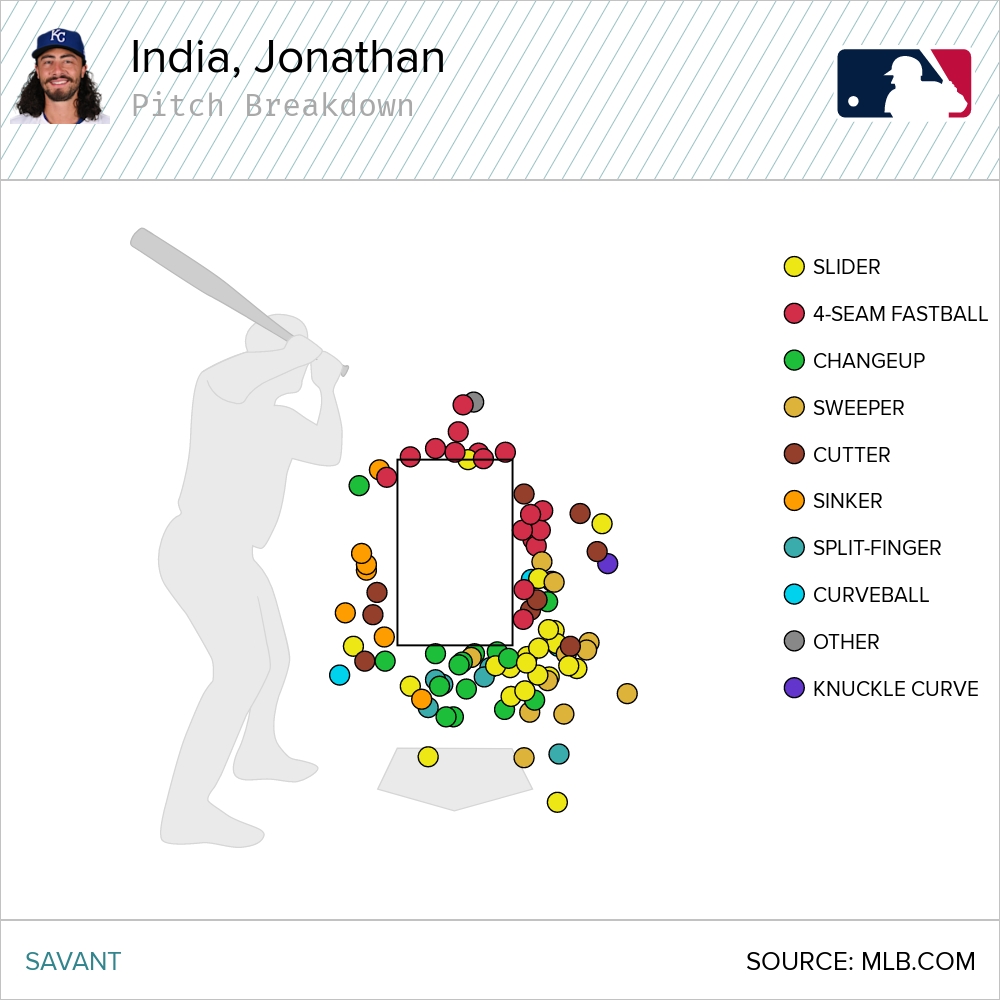
I don’t think there’s anything specific to glean from this, but if anything it’s an interesting look at how to get India out if you’re a pitcher looking for that third strike. It’s four-seamers up and also outside. But barely. It’s also sliders and change-ups down. He’s not all that different from most hitters in that regard. Notice there aren’t many curveballs on that chart at all.
That’s probably because India owns the curve. In 2025, he hit .375 with a .500 slugging percentage against curveballs. Alas, he saw a curve just 4 percent of all pitches.
That’s kind of the root of the issues surrounding India.

In 2025, India came to the plate 567 times. What happened at the first pitch he saw:
Called strike - 271
Ball - 211
Swing - 81
Hit by pitch - 4
If that looks like India was super passive at the plate on the first pitch of a plate appearance, that’s because he was. Percentage-wise, India looked at the first pitch 86 percent of the time. The league, on average, took the first pitch 68 percent of the time.
Of course, situation often dictates approach. For example, if India was leading off the game for the Royals, he probably wanted to make the starter throw at least a couple of pitches. It seems India is just not into the Esky Ambush. Yet that’s just one plate appearance. Maybe he leads off another inning and again decides to work the count. Oftentimes, though, he’s not. India was just incredibly passive at the start of plate appearances in 2025.
When hitters see ball one, that tilts the odds for the rest of the PA firmly in their favor. Alternatively, when the first pitch registers strike one, the advantage goes to the hitter. The difference that hinges on the outcome of a single pitch is stark. This is how the league hit in 2025 after seeing ball one and after seeing strike one:

That’s a whopping 57 point difference in OPS+. That’s going from Eugenio Suárez to Joey Ortiz at the plate. Just based on a single pitch.
India, you may be surprised to learn, does not have that kind of severe difference. These are his splits from 2025 after the first pitch was delivered:

India gets a lot of hate among the fanbase, but are you surprised that he’s an above average hitter when he moves ahead in the count after the first pitch? Likewise, he doesn’t do as bad as the league on average when he falls behind. The problem, as I stated above, is he looked at far too many first-pitch strikes last season.

Let’s get even more granular! You’ll recall from above that India swung at the first pitch 81 times last year. Here were the outcomes of that swing:
In Play - 36
Foul - 25
Whiff - 20
There’s a reason players like to swing at the first pitch: It’s often the best pitch they’ll see in a plate appearance. The league as a whole hit .338/.347/.577 when putting the first pitch of a plate appearance in play in 2025. India, as we can see, put the first pitch into play 36 times in 567 PAs, or just 6.3 percent of his times at the plate.
Maybe India was smart not to offer at the first pitch. When India’s at bat ended on the first pitch, he hit a meagre .143/.241/.229 with an OPS+ of 6. Yes, that’s an OPS+ of 6, meaning he was 94 percent worse than the average major league hitter when putting the first pitch into play. Yikes!
Sometimes, you run into a statistic that just has you shaking your head. I’m not here to argue that India is anything other than an average (at best) major league hitter. My argument was going to be that he was entirely too passive early in the count, fell behind and then couldn’t dig his way out. Yet he didn’t do that bad when he saw strike one on the first pitch. I’m shocked that he did so poorly on the first pitch of an at bat.

Since India doesn’t chase and doesn’t whiff all that much, he’s making his fair share of contact. His overall contact rate of 82.5 percent in 2025 was about six percentage points above league average. So what happens when he’s making that contact?
For starters, last season he hit the ball in the air more than he ever had before. He finished the 2025 season with a 45 percent fly ball rate. His previous high was a 40 percent fly ball rate in 2023. For a guy with modest power (if I’m being generous) putting the ball in the air more frequently is not a road map to hitting success. Especially given that India moved from the hitters haven of the Great American Ballpark in Cincinnati to the cavernous Kauffman Stadium.
When India hit a ball classified as a fly ball from Baseball Savant, it left his bat with an average exit velocity of 90.5 mph with an average launch angle of 37 degrees. If that sounds suboptimal to you, that’s because it is. Here's what it looks like in a spray chart.
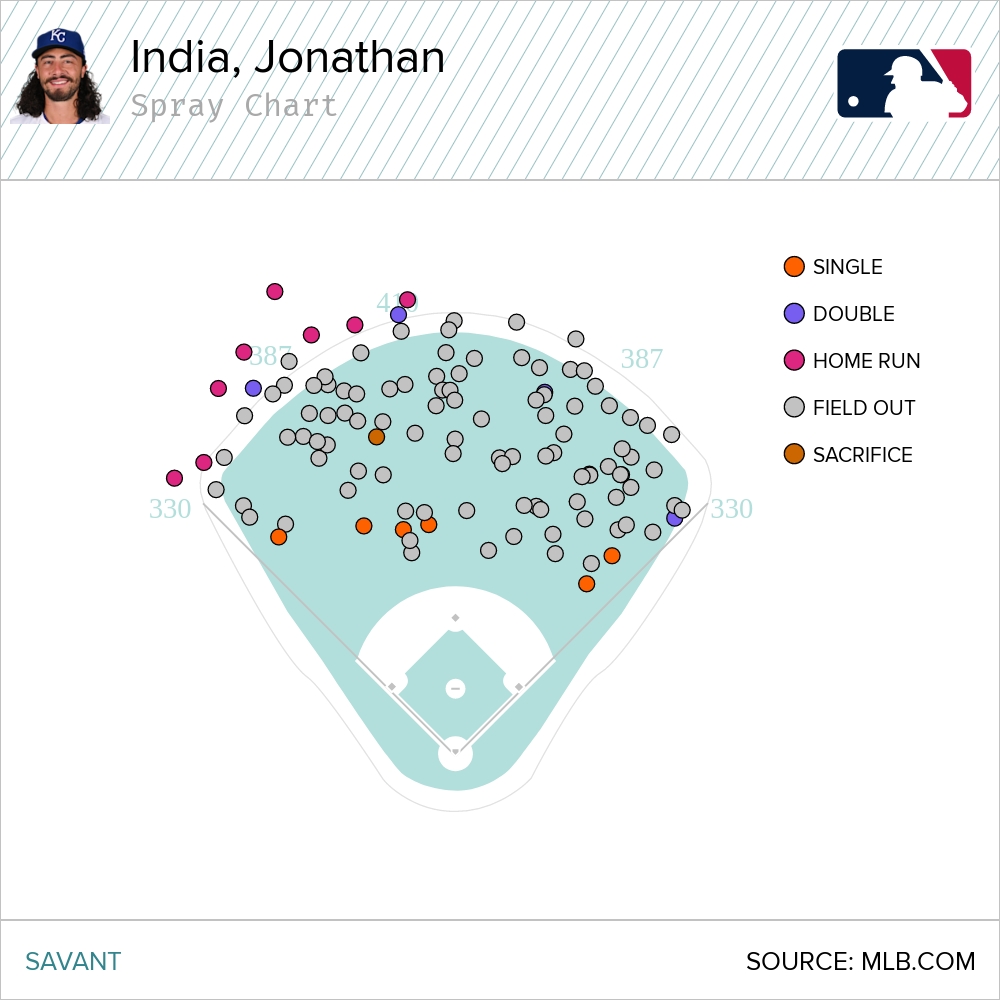
India doesn’t get pull happy when he puts the ball in the air, but he’s certainly not hitting the ball with any kind of authority. There are just outs. Lots and lots of routine outs. This was why I didn’t see India as a good fit for Kauffman Stadium when the Royals acquired him.
Part of the balls in the air equation is also line drives. The conventional wisdom on liners are they will fall for hits around 75 percent of the time. Part of his increase in fly balls, came at the expense of line drives. Last summer India posted a career-low 16.8 line drive rate, the first time in his career he finished below 21 percent. His batting average when hitting said line drives was good—he hit .721—but again, the drop in the overall number hampered his ability to overcome an all around below average performance. Here is India’s line drive spray chart from 2025:
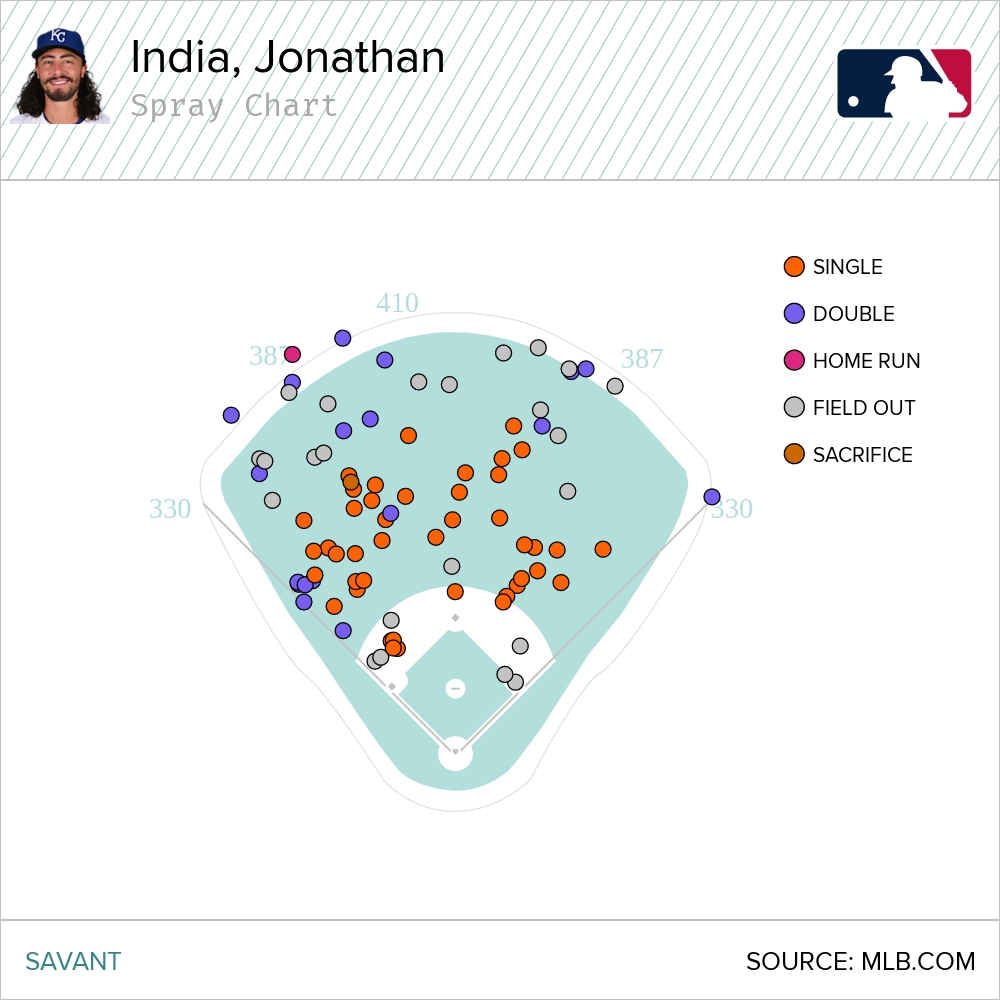
He pulled the ball more when hitting a line drive, but with an average exit velocity of just above 92 mph, most of those hits went for singles. That’s fine, but a hitter who profiles as a strong fit at The K would likely have a few more liners to the gaps for doubles and the occasional triple.

Now for the psychological portion of this entry. India, as we all know, was asked to move off his normal position at second base last season. He alternated between third base and left field, two positions he had never played in the major leagues in his career, for the first quarter of the season. He did not appear at second base until a May 11 loss against the Boston Red Sox.
After May 13, India only played at second.
In retrospect, it was folly for the Royals to try to move India off his natural position. He has never been a good defensive player at second to begin with. And while he had played third base in college, outfield was a totally new experience. Some players can handle moving around the diamond. It’s clear that India isn’t one of those players. Likewise, some players can deal with their defensive shortcomings and not bring those struggles to the plate with them. I wonder if India just had a difficult all around time trying to make those adjustments. From Anne Rogers last December:
“You talk to [India], he wasn’t happy with the quality of his at-bats,” Quatraro said. “He knew he was popping too many balls up. It wasn’t that he was trying to hit homers, he just couldn’t get out of that swing funk. But I think more than anything, I would attribute a lot of that to the fact that he was trying to learn two new positions in Spring Training, and went into his first year with a new organization out of his comfort zone.”
Then there was the fact he was drilled in the head by a pitch in the third game of the season, a 99 mph cutter from Cleveland’s Emmanual Clase. He did fine in the immediate aftermath, collecting three hits in Milwaukee a day later, but he went into quite the offensive tailspin in early April where he hit just .114/.250/.182 over his next 52 PAs. He never really recovered.
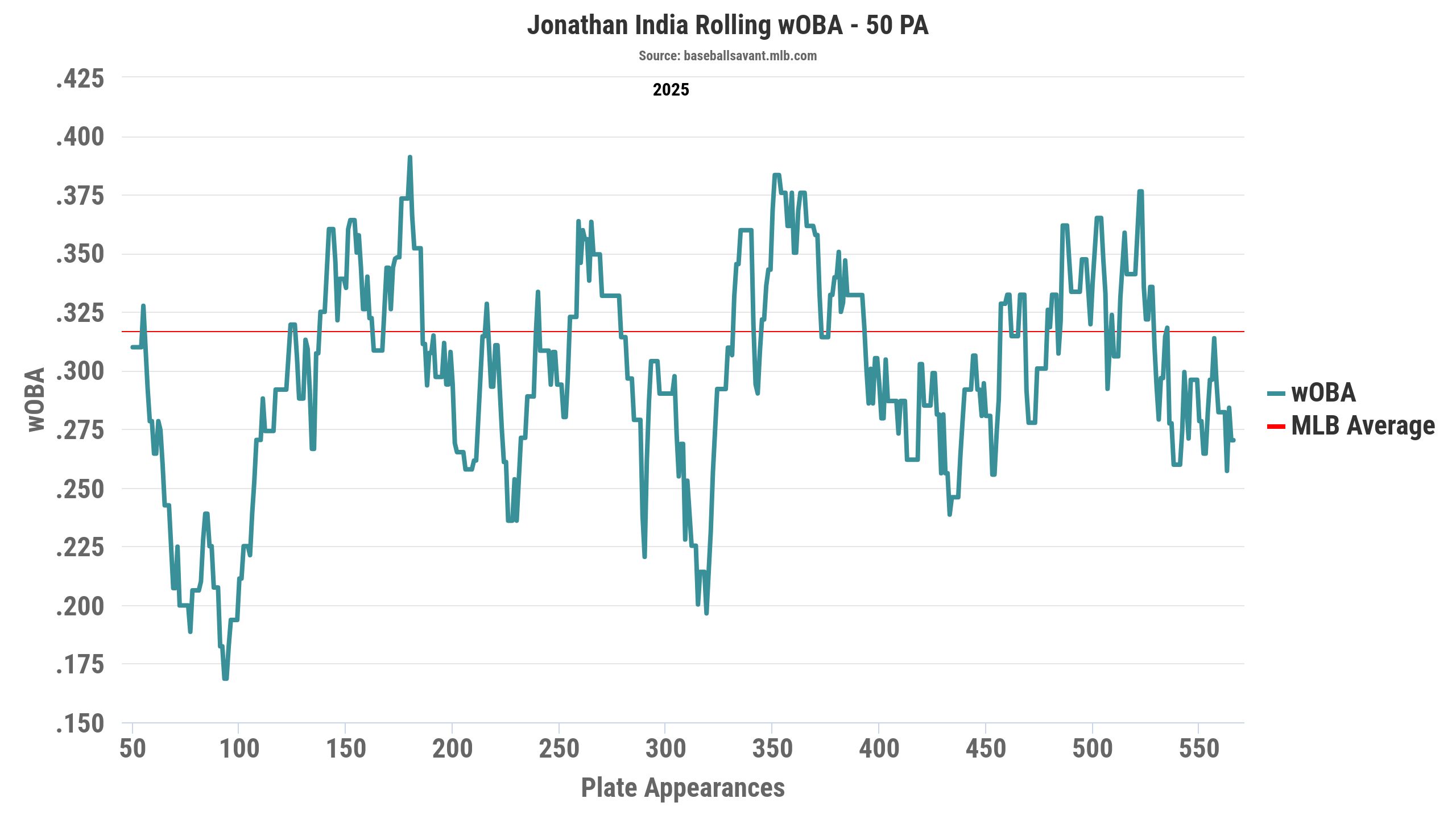
His rolling wOBA chart from Baseball Savant (which measures overall offensive productivity) shows stretches of good offensive play. But the time spent below the MLB average line is much more frequent than the time above and the valleys are much lower than any of the peaks are high.

The Royals, for now, appear to remain committed to India. Perhaps a full season back at second base will help.
When I began this exercise, I thought the conclusion would be for India to be more aggressive at the plate. Not being so passive and not falling behind in the count early would better tip the scales in his favor. Given his results last season in favorable hitting counts, now I’m not so certain. And given his batted ball data, I continue to think he’s just not the best fit for Kauffman Stadium.
The Royals need to get somewhere around 1.0 fWAR to get a positive return on their $8 million investment. It’s not an insane ask, even though India finished with negative fWAR last year, he posted a 2.9 fWAR as recently at 2024. Bad defense doesn’t help, but he should be improve there in 2026 if the Royals keep his glove out of the outfield.
More Quatraro:
“[India] will have an inside track to play on a regular basis,” Quatraro said. “That’s why we acquired him, because we really value the on-base and the leadoff ability and the neutrality of the splits and all those kinds of things. You come into the season thinking about him as an everyday player.”
It sounds as though the Royals will try him back at the top of the order, with Isaac Collins likely hitting in the bottom third. I don’t have a problem with this. If India is getting on base with increased frequency, then that’s a good thing for Bobby Witt, Jr., Vinnie Pasquantino and Maikel Garcia. If India struggles again, I imagine the first move we will see is him dropping in the order.
Even with all of his issues last season, India represented improvement as a leadoff hitter. That’s not praise for India. That’s just how bad the Royals were at the top of the order in 2024.
At FanGraphs, ZiPS projects India will hit .238/.336/.368. Steamer puts him down for .248/.339/.383. Both projections see improvement. Both see India in the 100 wRC+ range. Which would make him…average.
And there is value in average.

Comments ()