Garcia gets a payday
The Royals third baseman made slight adjustments that brought big results at the plate in 2025.
After the relative calm of the Winter Meetings for the Royals, JJ Picollo hit baseball’s transaction trifecta in the immediate aftermath.
I’ll define a transaction trifecta as a trade, a free agent signing and a contract extension. We’ve discussed two of those moves—the free agent signing of Lane Thomas and the trade of Angel Zerpa for Isaac Collins and Nick Mears—in this space. So let’s turn our attention to the third transaction: A contract extension for third baseman Maikel Garcia.
The signing became official on Tuesday afternoon. The nuts and bolts of said extension are fairly straightforward. It breaks down thusly:
2026 - $4M
2027 - $7M
2028 - $10M
2029 - $13M
2030 - $19M
2031 - $23M club option ($3.2M buyout)
Garcia will also net a $1.3 million signing bonus and there are some bumps on the 2030 and 2031 values based on some currently unknown performance incentives. Officially, it’s a five-year deal for $57.5 million dollars.
With this extension, the Royals are buying out all four years of Garcia’s arbitration eligibility as a Super Two player, plus one—and maybe two years—of his free agency. The contract dollars will increase by three million every season that would’ve been covered by his arbitration years before taking a larger leap for when he would’ve been a free agent. Garcia will by 30 years old in the 2030 season.
This seems like a very safe contract for Garcia and a very good contract for the Royals. It’s safe because should Garcia perform the way he did in 2025 going forward, his arbitration raises would’ve been a little more robust. And the way salaries are going these days, the dollars to cover his free agency years feel a little light. It’s not a robbery like the Royals first extension with Salvador Perez, but Garcia is going for some security here. And as I’m obligated to mention every time we near the end of a CBA, who knows how the fiscal landscape of the game will look by this time two years from now. There’s something to be said about safety and security.
For the Royals, this gives them some financial certainty while locking in the left side of their infield for the next several seasons.

A year ago, I’m not sure anyone was advocating for locking up Garcia to a long-term deal. Coming off a 2024 season where he hit .231/.281/.332 with a 71 wRC+, he wasn’t even guaranteed a starting spot for 2025.
Garcia worked last winter with centering his weight in the batter’s box in an effort to avoid jumping out at the pitch. As Anne Rogers wrote last spring, hitting coach Alec Zumwalt wanted Garcia to stop “crashing.”
“Crashing, for us, is when the foot gets down and everything is coming behind it with no ability to stop,” Zumwalt said. “So you’re basically in ‘go’ mode, and it’s really hard to adjust. If you guess right, it looks good. You guess wrong, you miss. With Maikel, what gives him so much hitting ability is he’s got such a flat swing through the zone, so he can be a little late and shoot the ball the other way.
“But we’ve talked about getting away from the crashing. He owned it. He felt his weight get too heavy on the front foot and knew he needed to be more adjustable.”
To combat this, Garcia widened his stance, straightened his front foot in the batter’s box and added a toe tap.
This is how Garcia positioned himself in 2024.
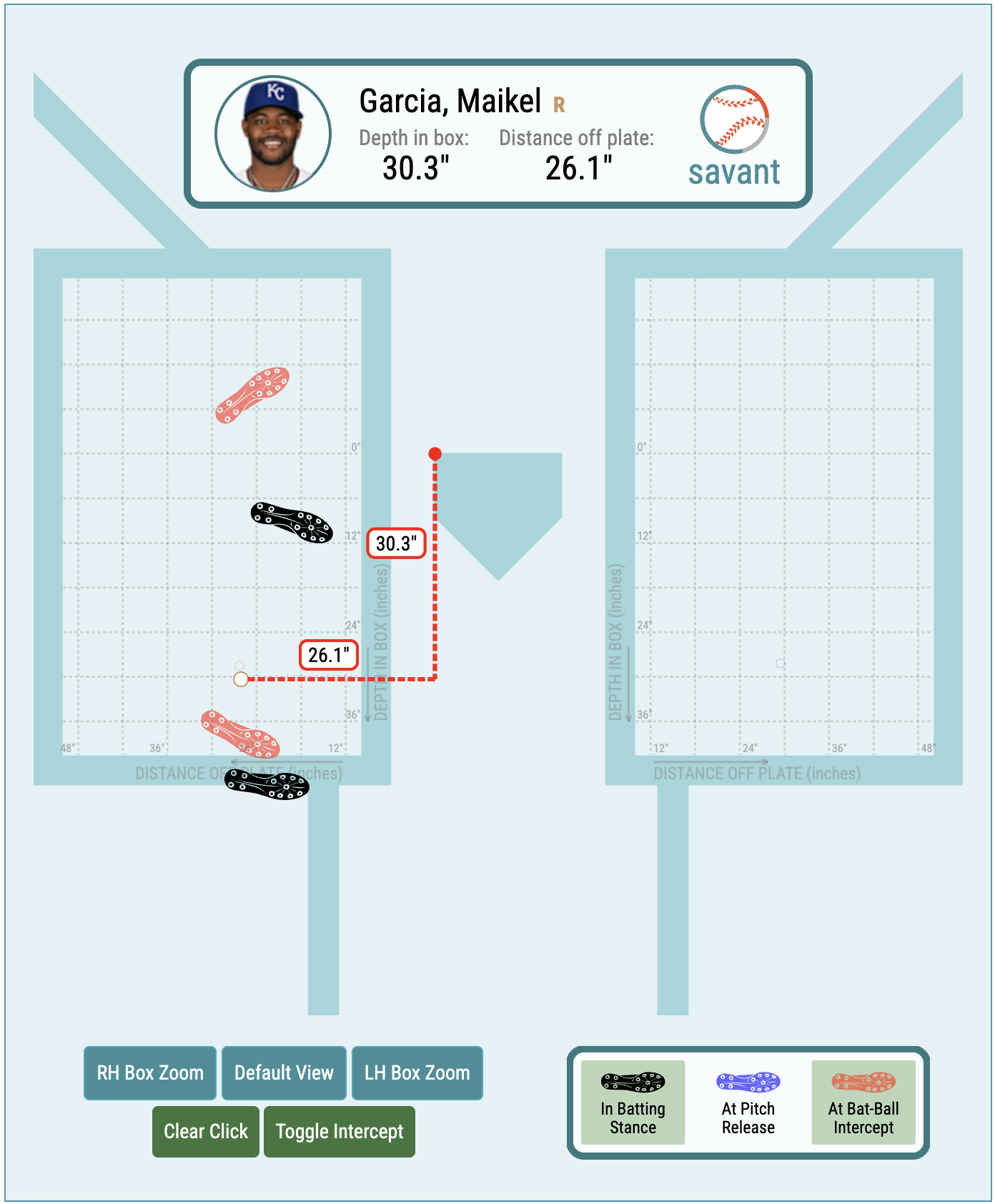
Note how his front foot while in his stance was turned slightly inward. That closed off his stance a little bit before he used a leg kick while the pitcher was delivering the ball.
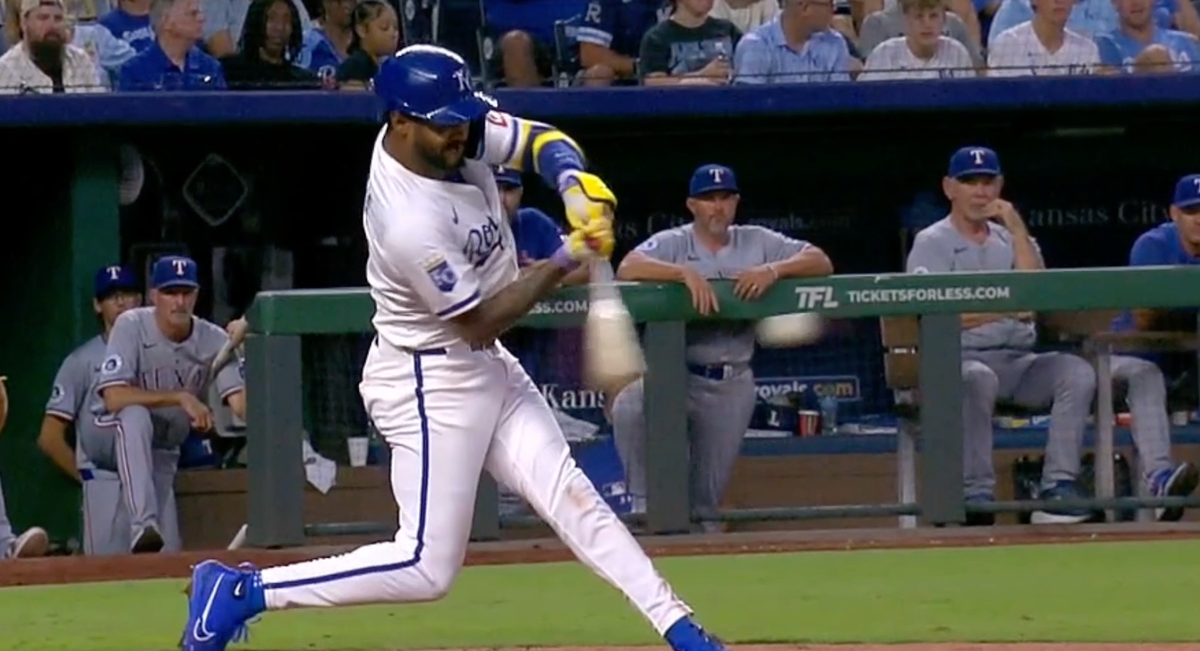
This is what that leg kick looked like:
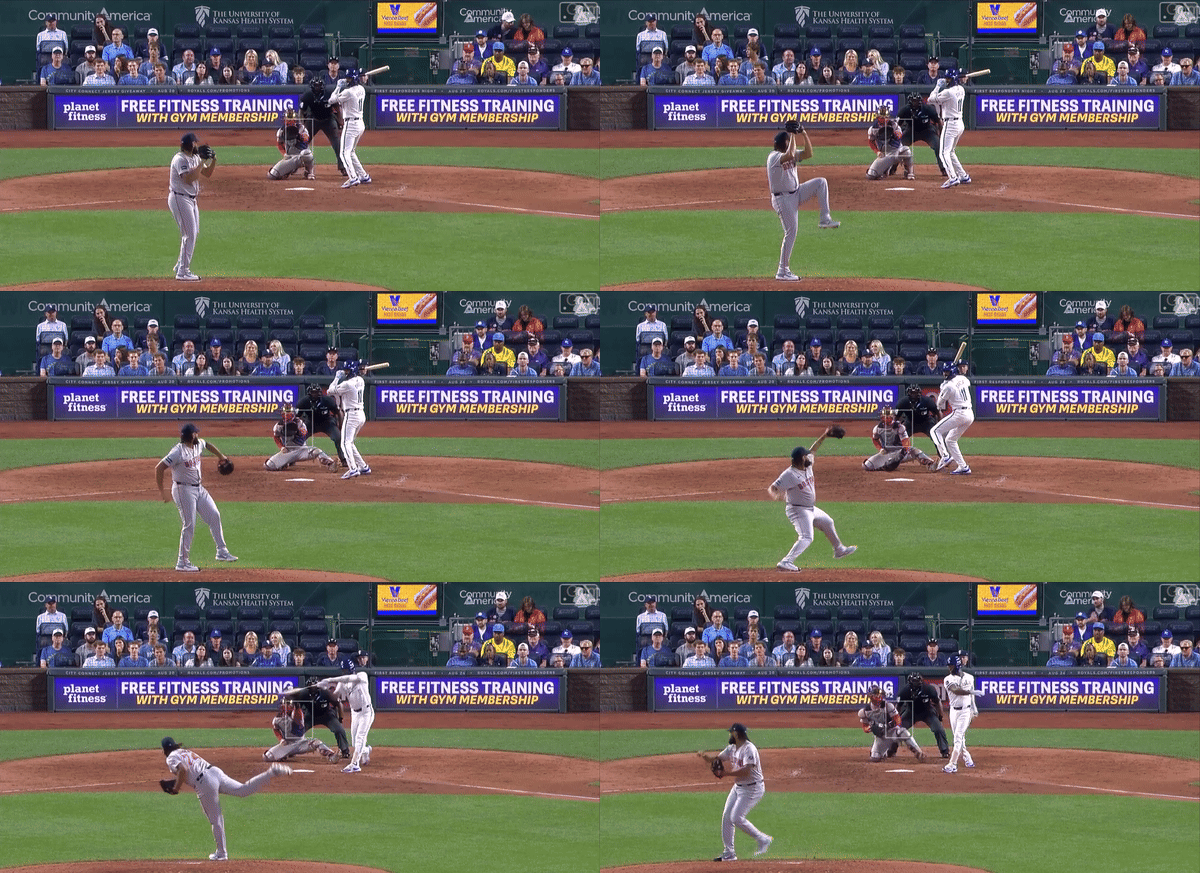
It wasn’t what I would call exaggerated, but it certainly had some sort of hang time. That front leg was in the air for a long time. That’s what was causing him to “crash” as Zumwalt called it. Sure, he’s chasing a comically high fastball in the GIF above, but the movement was uniform throughout the 2024 season. To my untrained eye, he’s snatching at the pitch which gives the pitcher the upper hand in this confrontation.
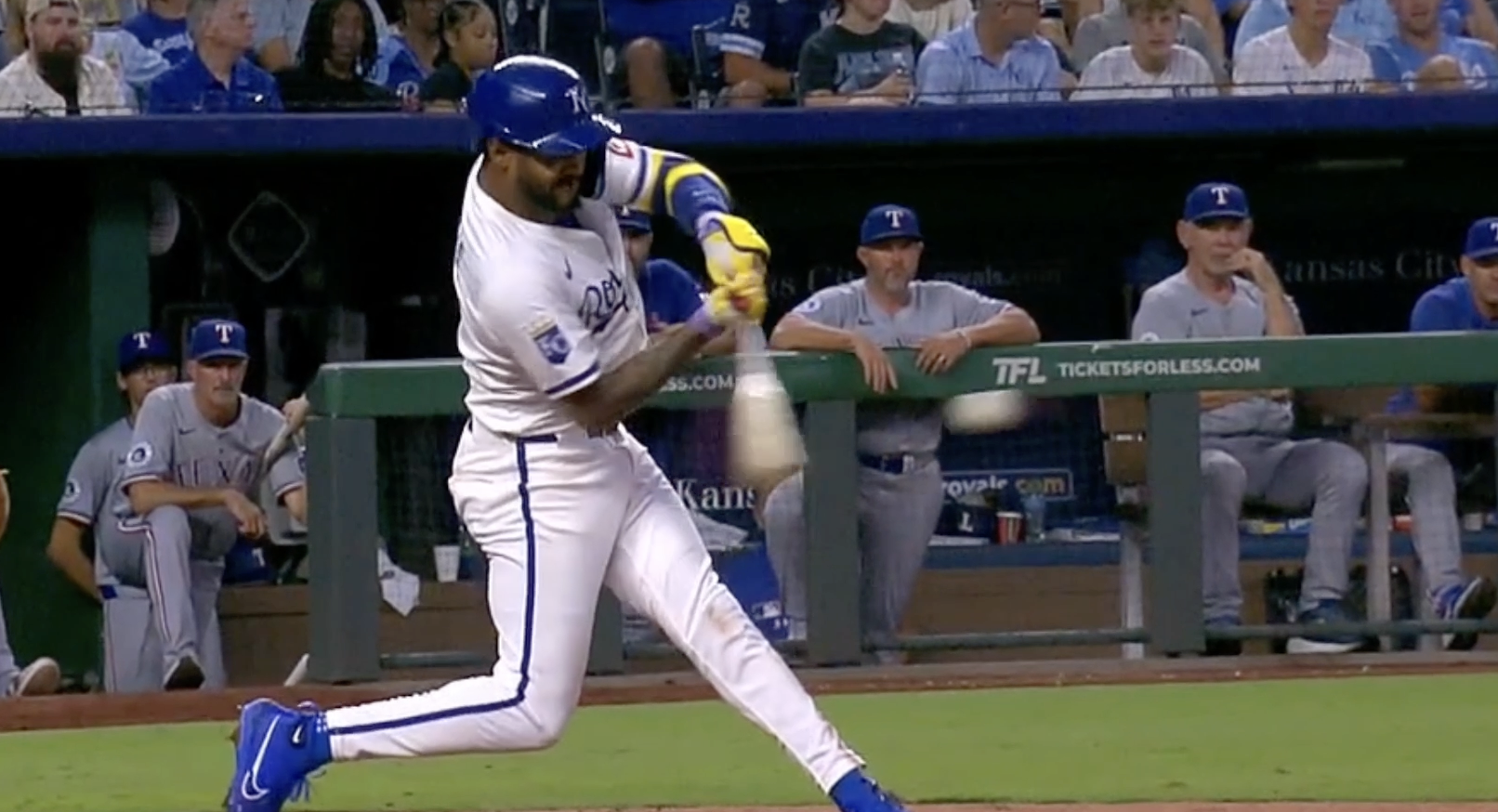
This is how Garcia positioned himself in the box in 2025.
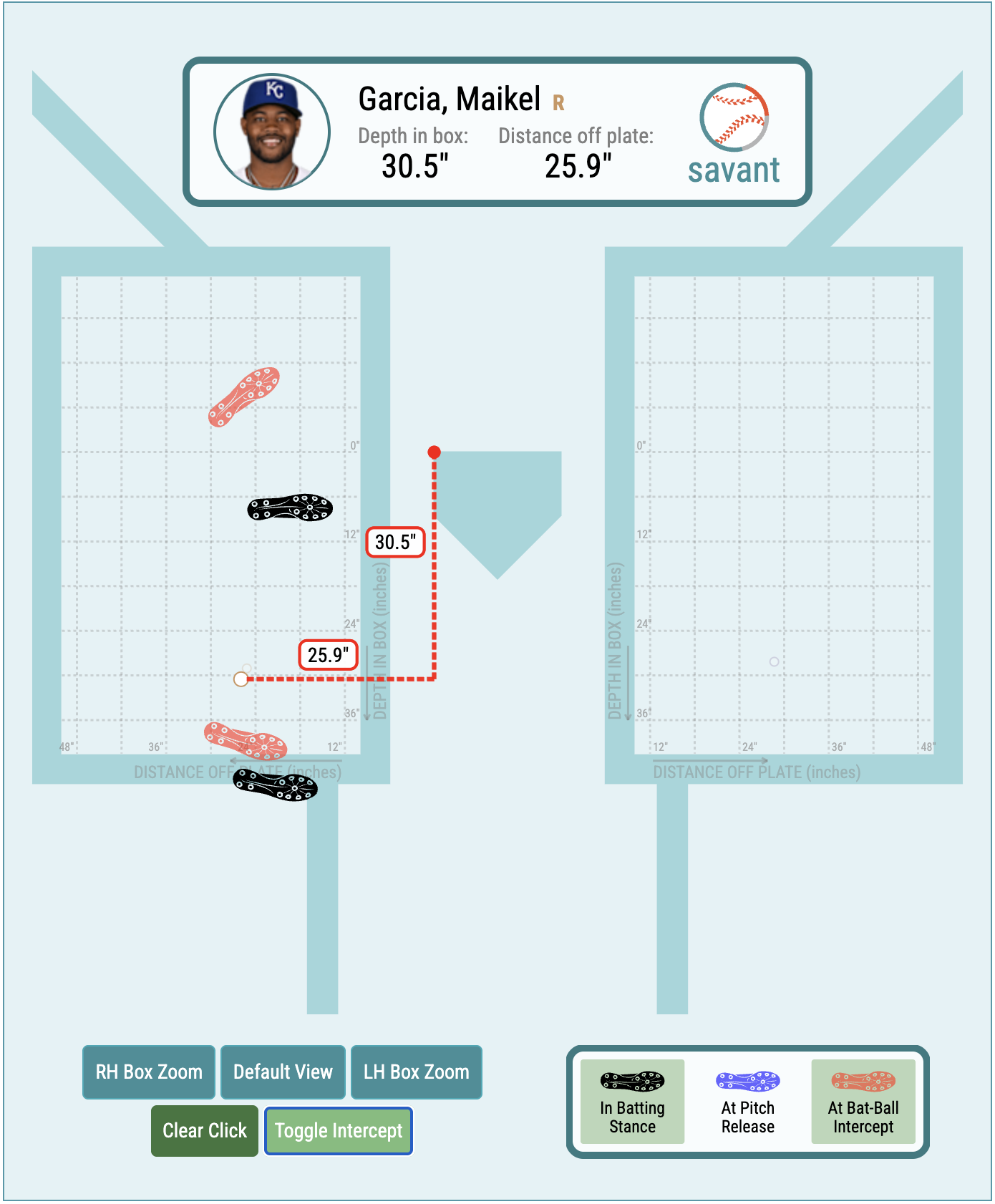
Honestly, there’s not much of a difference between the two seasons other than the space between his feet and straightening of his front foot. Everything else is very close. Aside from the toe tap, the mechanics of Garcia’s swing remained somewhat consistent from season to season. The attack angle was 5 degrees both seasons. Same for the swing tilt path at 28 degrees. However, he gained a tick on his bat speed, going from 70.8 mph and the 34th percentile to 71.9 mph and the 46th percentile.
The toe tap is simply a gentle timing mechanism that clearly helps Garcia keep his balance centered at the plate, which allows him to get a little more whip through the zone. And he can turn on pitches waaaaay inside.
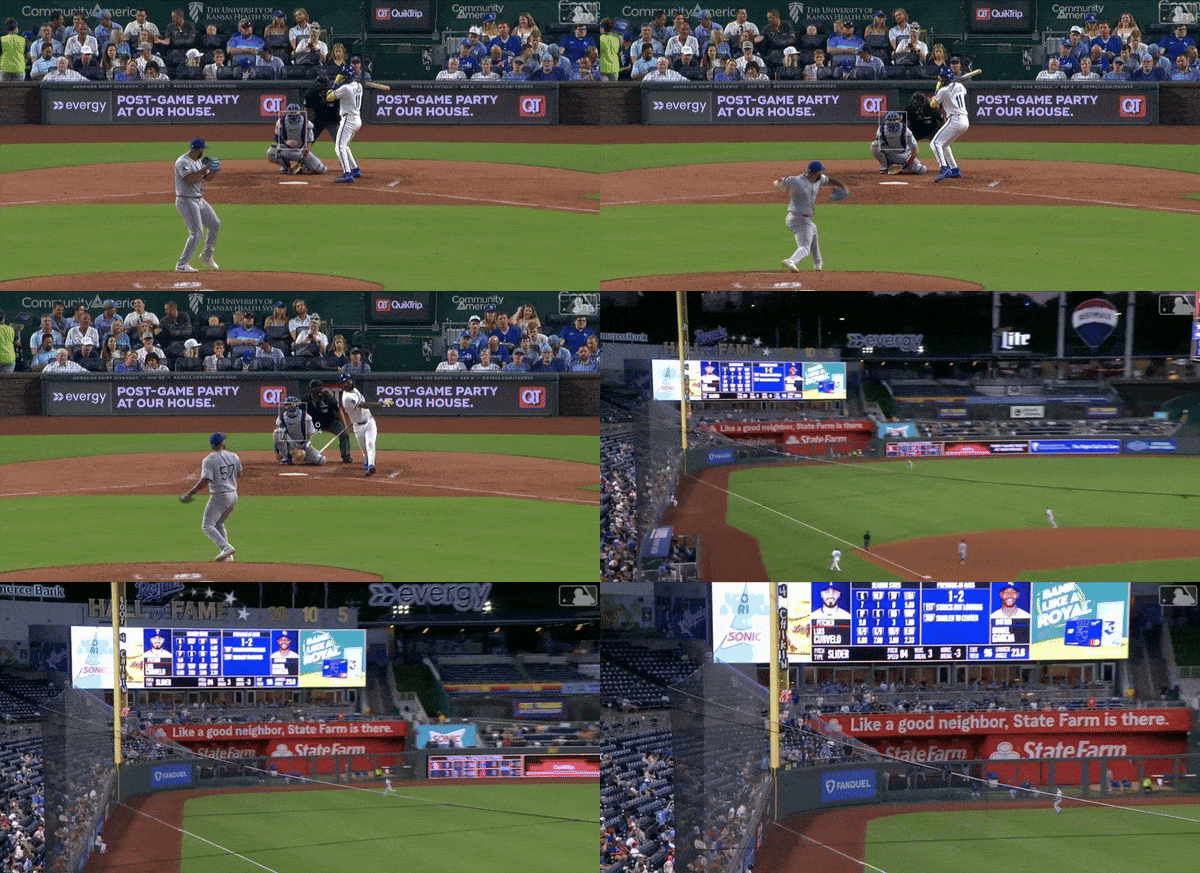
It’s just a more aesthetically pleasing movement than lifting his left leg and having it float in something of a perpetual suspension. He’s back and fluid and able to get around on a pitch located on the inside part of the plate. Clearly, this brought the results the Royals and Garcia long desired.
Garcia finished the 2025 season at .286/.351/.449 with a 121 wRC+. It was a 50 point bump in his wRC+. He went from a well below average hitter in danger of losing his regular role on this team to a well above average hitter who went to his first All-Star Game and garnered down ballot MVP support. Oh, and that contract extension.

I wrote this about Garcia last March, in the season’s first weekend:
We’ve been over this before: For Garcia to realize his full potential, he has to hit the ball in the air. And when he hits the ball in the air, he has to pull it. Last year, Garcia put it on the ground nearly 50 percent of the time. Far, far too high. He hit a fly ball around 20 percent of the time. Far, far too low. And when Garcia hit the ball in the air, he rarely pulled it. Of the balls put in play off his bat in 2024, just 10.8 percent were pulled in the air.
Recall last year that Garcia launched three home runs in the first six games of the season (two to the pull field and one the opposite way). I raved about what looked to be a new approach where he would increase his average launch angle and put the ball more in the air. That…did not stick.
We’ll see how this plays out over the course of the next 160 games. What we do know: Good things happen when Garcia pulls the ball in the air.
This has long been the mantra of this publication: Good things happen when Garcia pulls the ball in the air. And what do you know…Garcia did hit the ball in the air more in 2025!. He also pulled the ball more. And his home run totals jumped from seven in 2024 to 16 in 2025. He added over 115 points to his slugging percentage. Wowza.
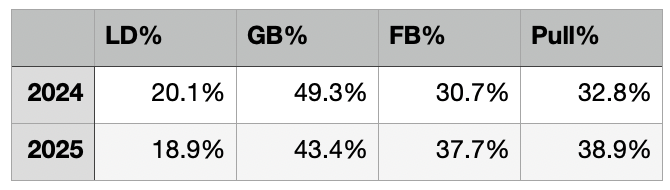
These shifts were substantial. He ceased being a ground ball machine and found the loft that we had all been waiting for. Once he hit the ball in the air a little bit more often and pulled the ball with greater frequency the power arrived. According to Statcast, in 2024 just 10.8 percent of all balls Garcia put into play were hit in the air to his pull side. That was low enough that he had the dreaded blue shade over his rate to represent a mark in the lower percentile range. In 2025, that rate jumped to 16.2 percent.
Again, the swing changes were in his stance and in his legs. Every thing from his arms to wrists to torso remained virtually unchanged. But those lower half adjustments were enough to unlock his potential. Garcia’s average launch angle went from around six degrees to almost 10 degrees. Just that little bit was enough to change everything.

In my analysis of the Collins trade, you saw the table I posted where Garcia finished 15th in the majors last year in chase rate (among those with at least 400 plate appearances.) While he was adding power to his game, the dude actually cut down his strikeout rate. It was 22.3 percent in 2023. It dropped to 16.5 percent in 2024. Last season it was an astonishing 12.6 percent. His chase rate was around 20 percent, which was right in line with his career averages. Garcia’s contact rate of 87 percent was likewise in line with what he’s normally done. It’s just the guy didn’t miss when he went on the attack. And he was on the attack early and often.
His profile at Baseball Savant is dead sexy.
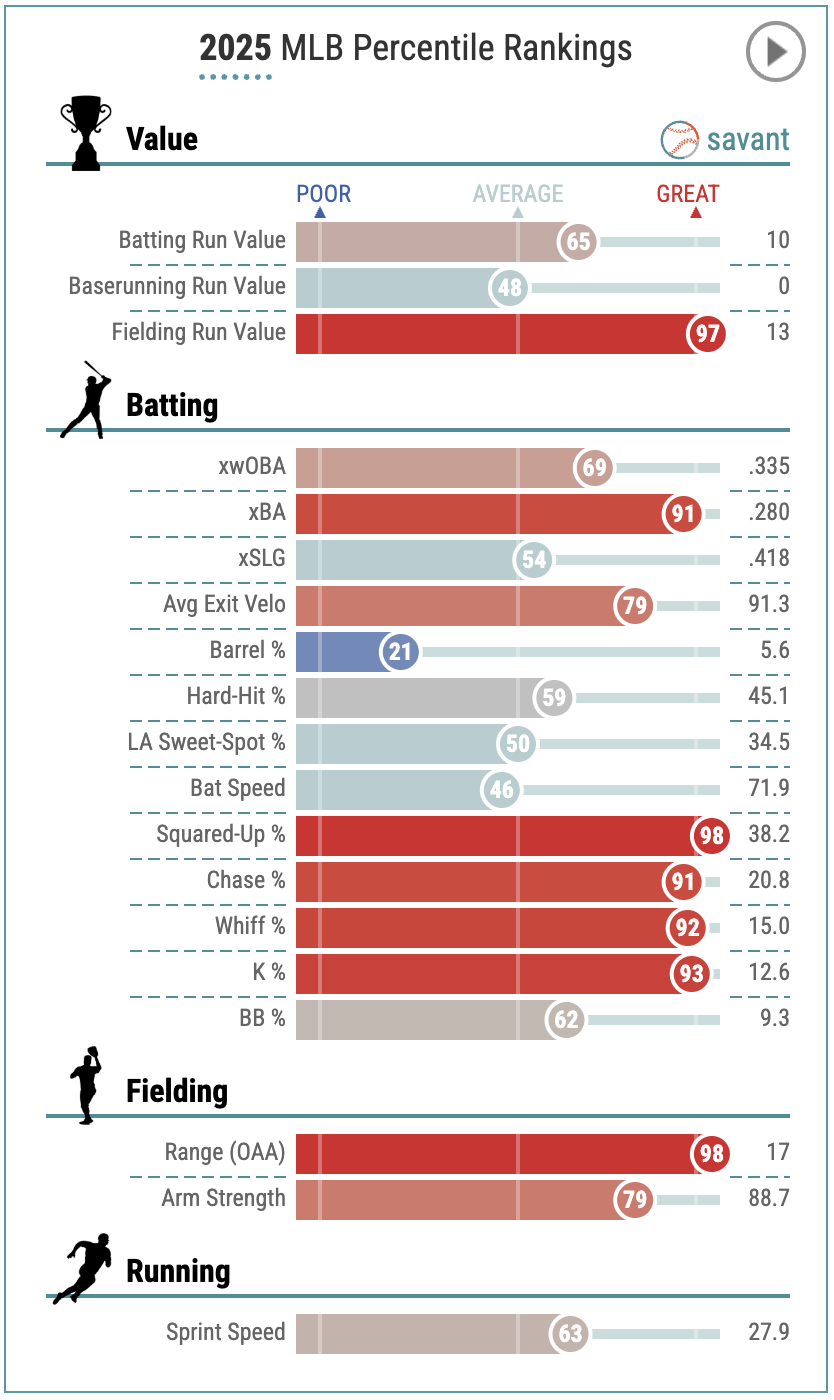
Garcia has always been a disciplined hitter, which is an excellent foundation to build from. The 2025 season was when he put it all together. Everything on the top half of the batting section increased. His expected batting rates all went up as did his batted ball metrics. More barrels, more exit velocity and more hard hit balls. All thanks to some minor adjustments to his batting stance.
What a success story.

While Garcia was making enormous strides in his offensive game, he turned in an absolute gem of a season with the glove. Among third basemen, Garcia was second in the majors with 14 Fielding Runs, trailing only Ke’Bryan Hayes who finished with 17. No other third basemen had more than seven Fielding Runs.
Garcia tallied 18 Outs Above Average at the hot corner, again trailing only Hayes who had 21 OAA. Again, no other third basemen finished with more than seven OAA. Clearly Garcia was the class of third basemen in the American League, while Hayes could claim the honors in the Senior Circuit.
I’m not sure there’s a third baseman in either league who charges the ball better than Garcia.
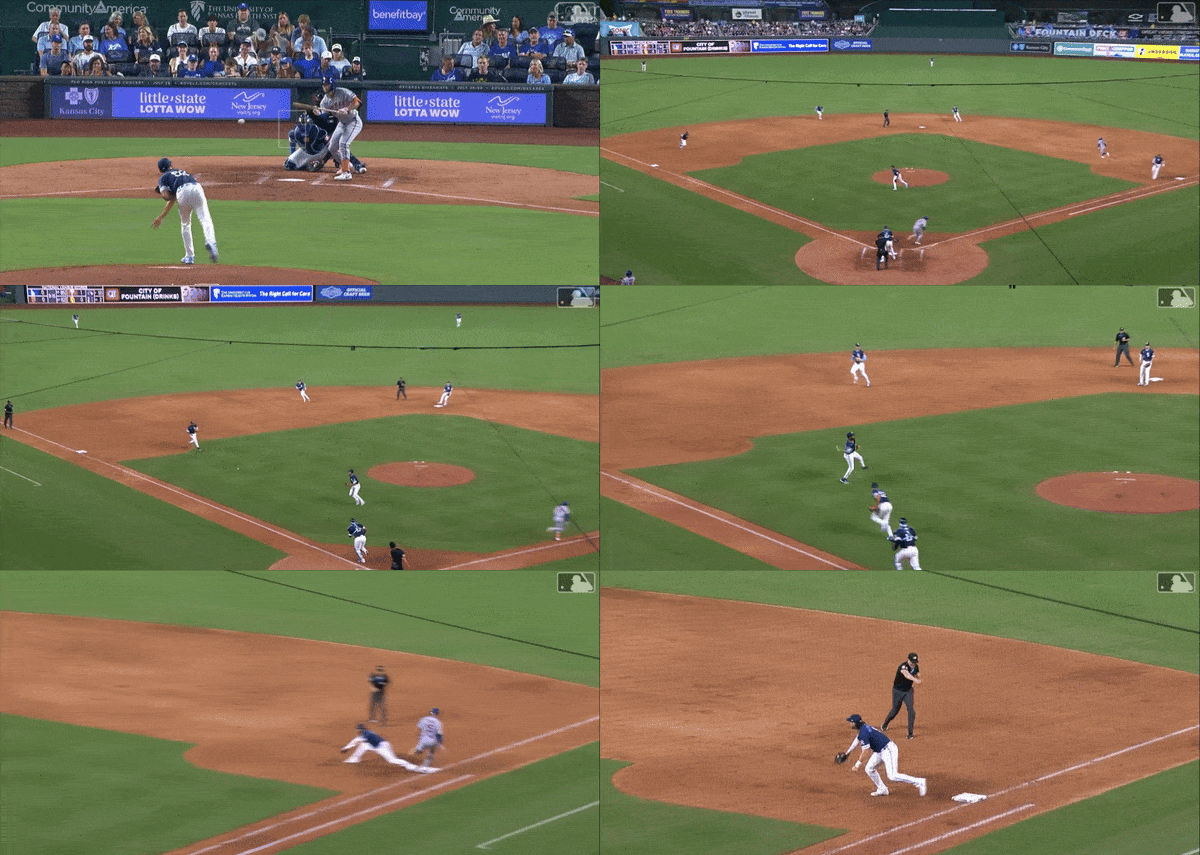
Everything…the first step, the footwork as he closes in on the ball, the way he twists to reach the ball with his bare hand to the point where he is actually facing first base as he moves into an upright position to unleash a laser of perfection…It’s defensive poetry.
Garcia claimed his first Gold Glove at the position, a well-deserved honor. Together with Bobby Witt Jr. on the left side of the infield, the Royals have an airtight defense. Now with Garcia’s extension, that dynamic defensive duo will be in place for at least the next five seasons.
Comments ()