One swing
Lane Thomas saves the game for the Royals with one swing of the bat.
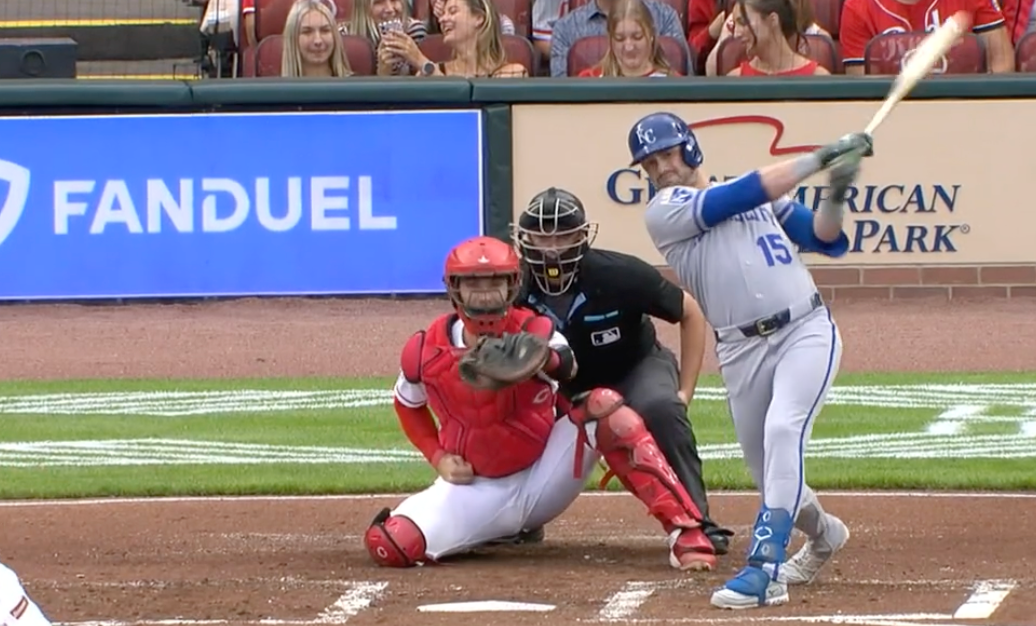
Today, we are going to focus on one swing in one at bat. While I'm not a believer in momentum in baseball—as the cliché goes, momentum only goes as far as the next day's starting pitcher, or, as we have painfully learned of late, that evening's bullpen—it was the most important swing for the Royals that I can remember in some time.
While I'm not going to pontificate about how the season could turn on a swing by Lane Thomas, it is worth acknowledging that it most likely saved the Royals from what could've been another painful evening. Thomas' swing was worth four runs and a massive first inning lead. The Royals rode that swing to a 9-2 victory over the Cincinnati Reds.
Fun baseball was back for at least one evening. That's worth celebrating.

One swing, while massively important, does not live in a vacuum. It's important to describe and dissect the events leading up to that moment.
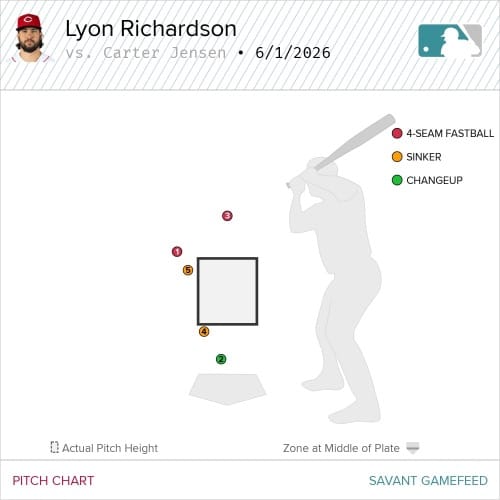
Right-hander Lyon Richardon was Cincinnati's choice to go first in a bullpen game. He had a tenuous relationship with the strike zone from the jump. He fell behind leadoff hitter Carter Jensen 3-0, got a courtesy strike from the home plate umpire, and lost him on the next pitch. While I still entertain myself by shouting "TAP" at the television, rooting on any hitter or catcher to challenge an egregiously called pitch, I will concede that to issue a challenge so early—and on a pitch that was down—isn't the best strategy. So it was nice that Richardson did Jensen a solid by delivering that fifth pitch off the plate for a free pass to open the game.
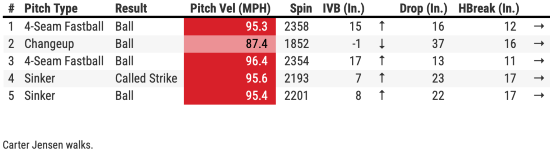
Bobby Witt Jr. was next. He, too, watched pitches sail past the zone and jumped ahead in the count, 2-0. After Richardson coaxed a slider just inside the upper edge of the zone, Witt watched another ball sail wide. Richardson then decided he didn't want to walk Witt...so he plunked him with a 3-1 changeup that he yanked. (I am not making the case that Richardson hit Witt on purpose. Had he been throwing intentionally at Witt, he certainly would've missed.)
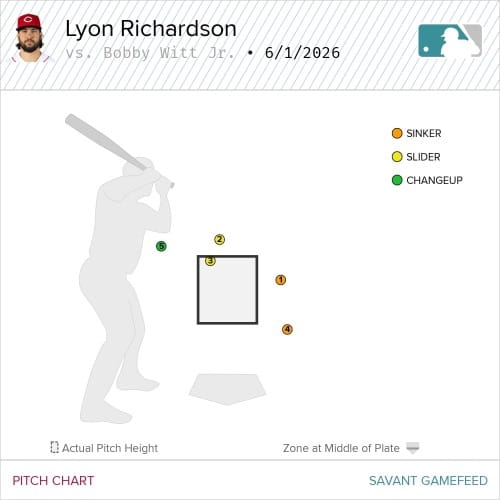
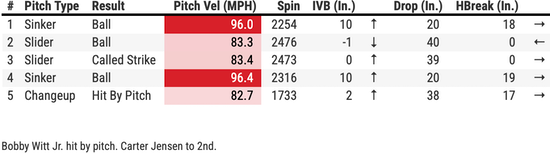
A brief recap: Cincinnati starter Richardson threw 10 pitches to the first two batters of the game. One pitch was located in the strike zone. One was called a strike but it wasn't. The opening tally: Eight balls and two strikes.
With runners on first and second, the Royals had something cooking. Rather, they should have something cooking, if they were a competent offensive team. We've seen this scenario unfold a few times this season where the first couple of hitters reach only to be left on the bases after the three, four and five hitters fail to deliver. Entering play on Monday, the Royals had scored 21 runs in the first inning all season. The average major league team had touched the plate 32 times thus far in 2026. The Royals 21 first inning runs ranked 28th.
As disappointing as Vinnie Pasquantino's season has been since he was getting beaned up in the WBC, his bat has been smoldering of late. Prior to Monday, he had collected a hit in seven on his last nine games. Over that span, he was hitting .281/.395/.375. The lack of power is still a massive concern, but it's good to see him starting to find something of a groove at the plate. Richardson chose to pitch Pasquantino away.
Of course, Richardson chooses that moment to actually execute on his changeups.
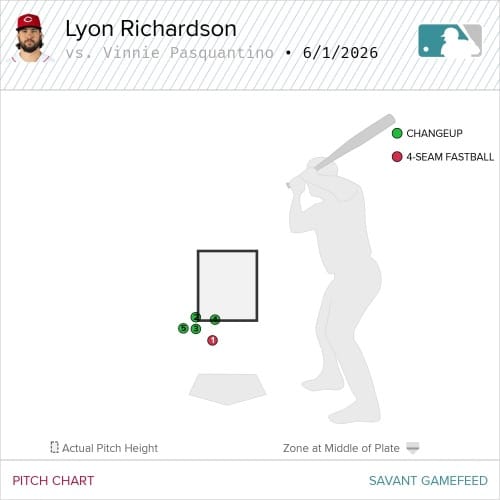
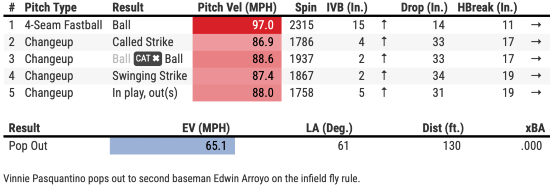
The next batter was Jac Caglianone. Do you think he was looking changeup away? After seeing how Pasquantino was pitched, I bet he was. And he got the pitch. And like the four delivered to the Royals first baseman, Richardson delivered a beautifully located cambio that Cags offered at and missed.
After that opening strike, Richardson decided to mix things back up and go slider and four-seam and missed with both. By the time he went back to the change, he lost the feel for the pitch and buried both.
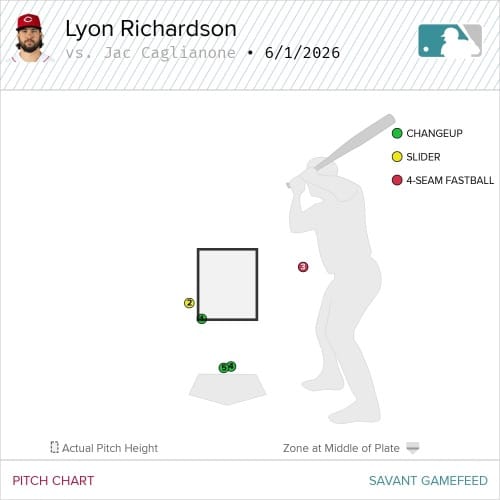
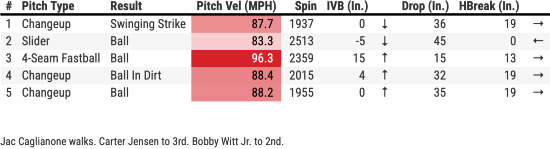
Let's do another quick recap. Richardson delivered a total of 20 pitches to the Royals first four batters. Four of them found the zone. He also got a courtesy 3-0 strike and had Pasquantino expanding the zone on a 2-2 change so officially, Richardson threw six strikes in his first 20 pitches. He walked two, hit a batter and recorded one out.
One of the more recent iterations of the Run Expectancy Matrix says a typical team will score around 1.6 times with the bases loaded and just one out. If that seems low, why not just blame the Royals? They have been the worst team in baseball at hitting with the bases loaded and one out. In 21 plate appearances in this situation, they have collected a grand total of one hit, batting a collective .071/.190/.071, good for a -29 OPS+. I promise I'm not going to bring this up in every single post (maybe), but it's instances like this that inspired me to coin the Zumwalt Number, the rate where Royals score runs while making outs. The Royals have scored just 11 times in this situation because they've hit four sacrifice flies and a couple of fielder's choices. They take a situation where they should score multiple times and often come away with just a single run...or nothing at all.
Isaac Collins was the next hitter. With a chance to do major damage, he saw three pitches. He started by looking at an elevated, ideal sinker from Richardson for a first-pitch strike. Like every other major league batter, the outcome of the first pitch for Collins lays the groundwork for the rest of the plate appearance. When the first pitch is a ball, Collins reaches base at a .405 clip. When it's a strike, his OBP drops to .266.
Collins then fouled off another sinker and then chased a changeup well out of the zone. Three pitches from Richardson, who had been struggling to throw strikes, and he got another out.
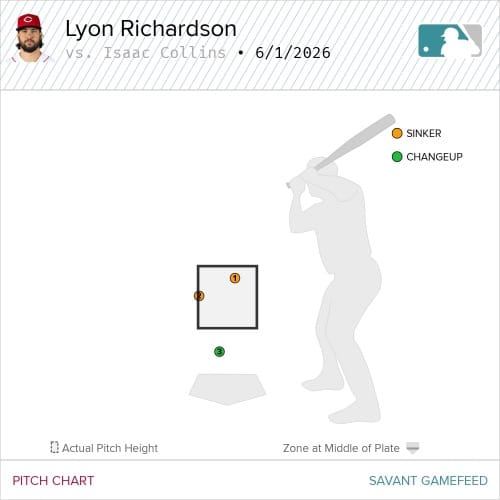
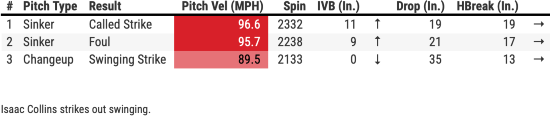
The Collins at bat was so deflating. His strikeout was worth around -0.7 runs, the difference in the Run Expectancy Matrix from one out with the bases loaded to two outs with the bases loaded. For a team like the Royals that has seen their offense mired in misery for pretty much the entire season, the Cincinnati Reds were presenting them with a fantastic opportunity. It was entirely within the realm of possibility that the Royals would look at that, sneer and say, "No thanks. We don't need your stinking runs."
This was a dangerous moment in the season. While I am of the belief that the Royals seen their opportunity for 2026 slip away and that they simply are not good enough to make any kind of sustained charge, to squander this opportunity while in the midst of a six-game losing streak where they've twice thrown games away in the later innings, would have been another devastating log to throw on the dumpster fire that has been this '26 season.
I think that a hitter, in that situation, has to go up there hunting fastball. Richardson, despite the three-pitch strikeout to Collins, had been scuffling with his location. He was on the edge with the bases loaded. He knows the importance of jumping ahead. This is a prime situation for a hitter to be looking for that ambush moment, betting on a pipe shot down the middle.
Thomas got that pitch.
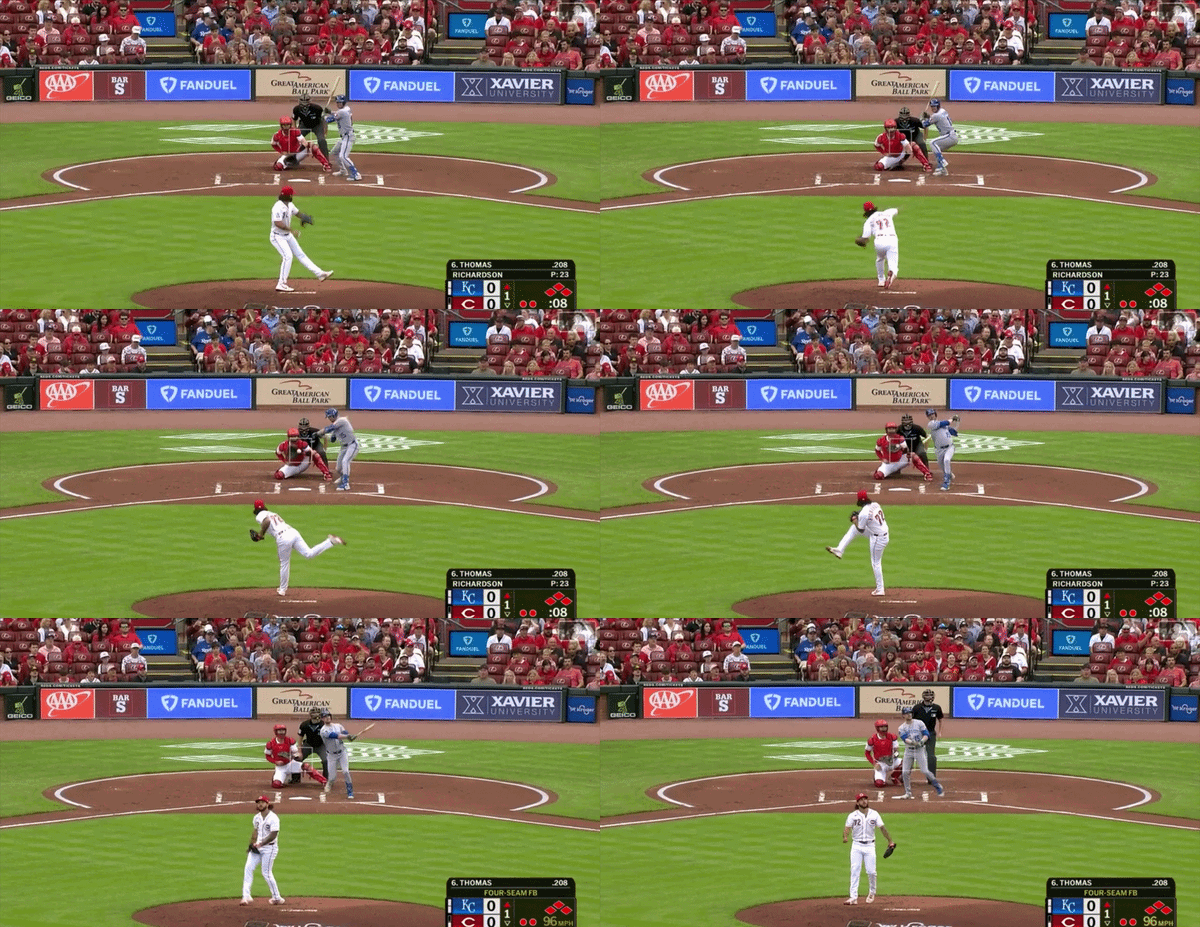
One swing, four runs. And a giant exhale coming from the Royals dugout. They were presented opportunity. Thomas took advantage.
That pitch looked every bit a get-it-over fastball that Thomas was hunting. Right down the chute.
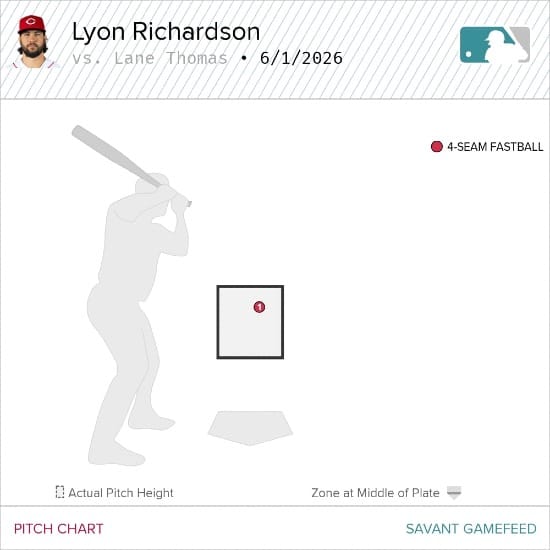
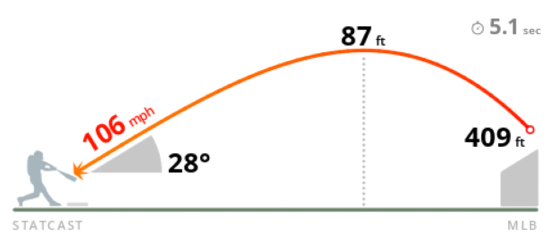
Thomas barreled the crap outta that baseball, launching it off the second-deck facade in left field. Great American Ballpark is a home run haven, but there wasn't a yard in the majors that would've held that rocket.
Could I interest you in another GIF, but closer and in slow motion? Of course you're interested!
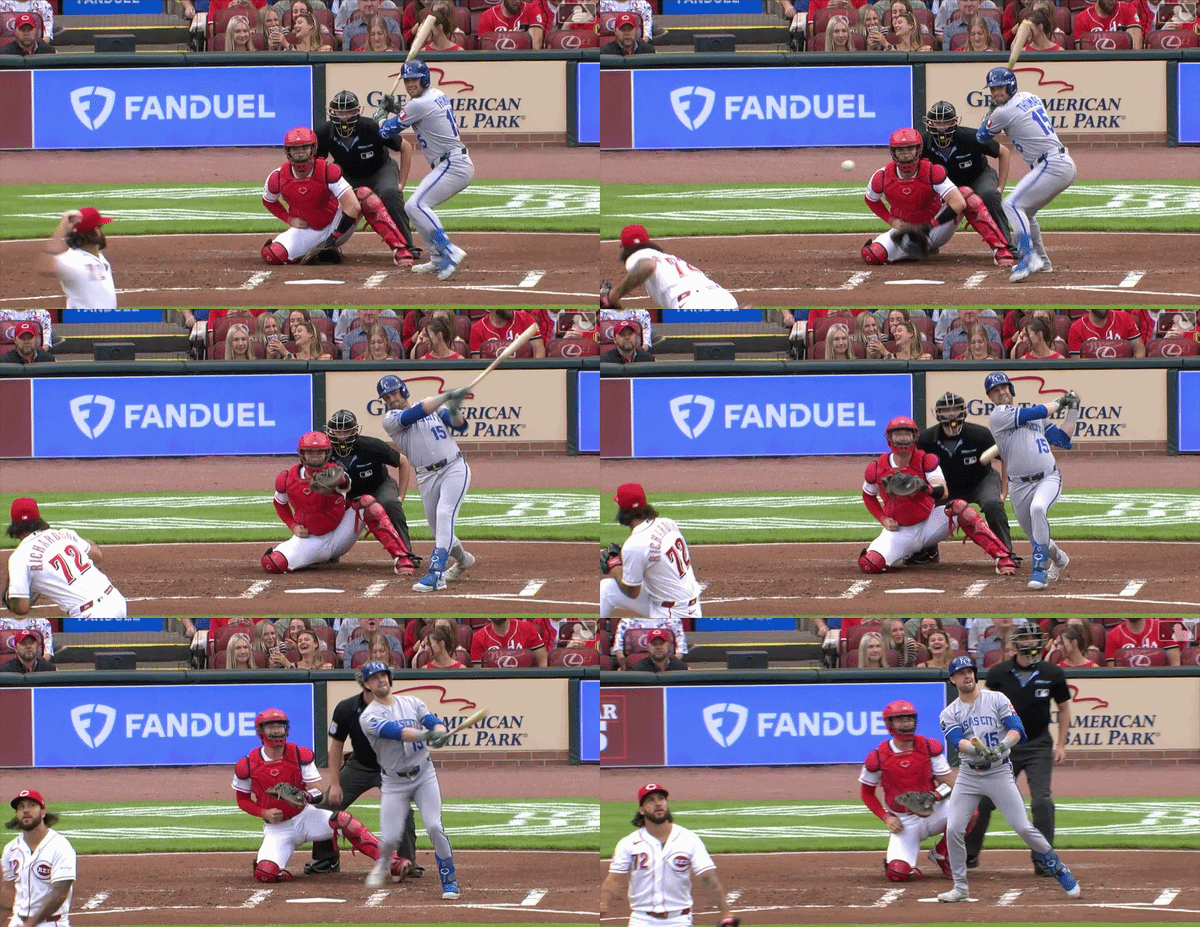
That's a great swing from a hitter who is looking pitch and location. Thomas' average bat speed in 2026 is 71.8 mph. That swing was clocked at 75.9 mph. Goodness, he was ready for that moment. Which is exactly what you want from a hitter in that particular situation. Richardson obliged. Thomas executed. One swing turned—and potentially saved—the game for the Royals.
The Win Probability graph illustrates just how massive that swing was for the Royals.
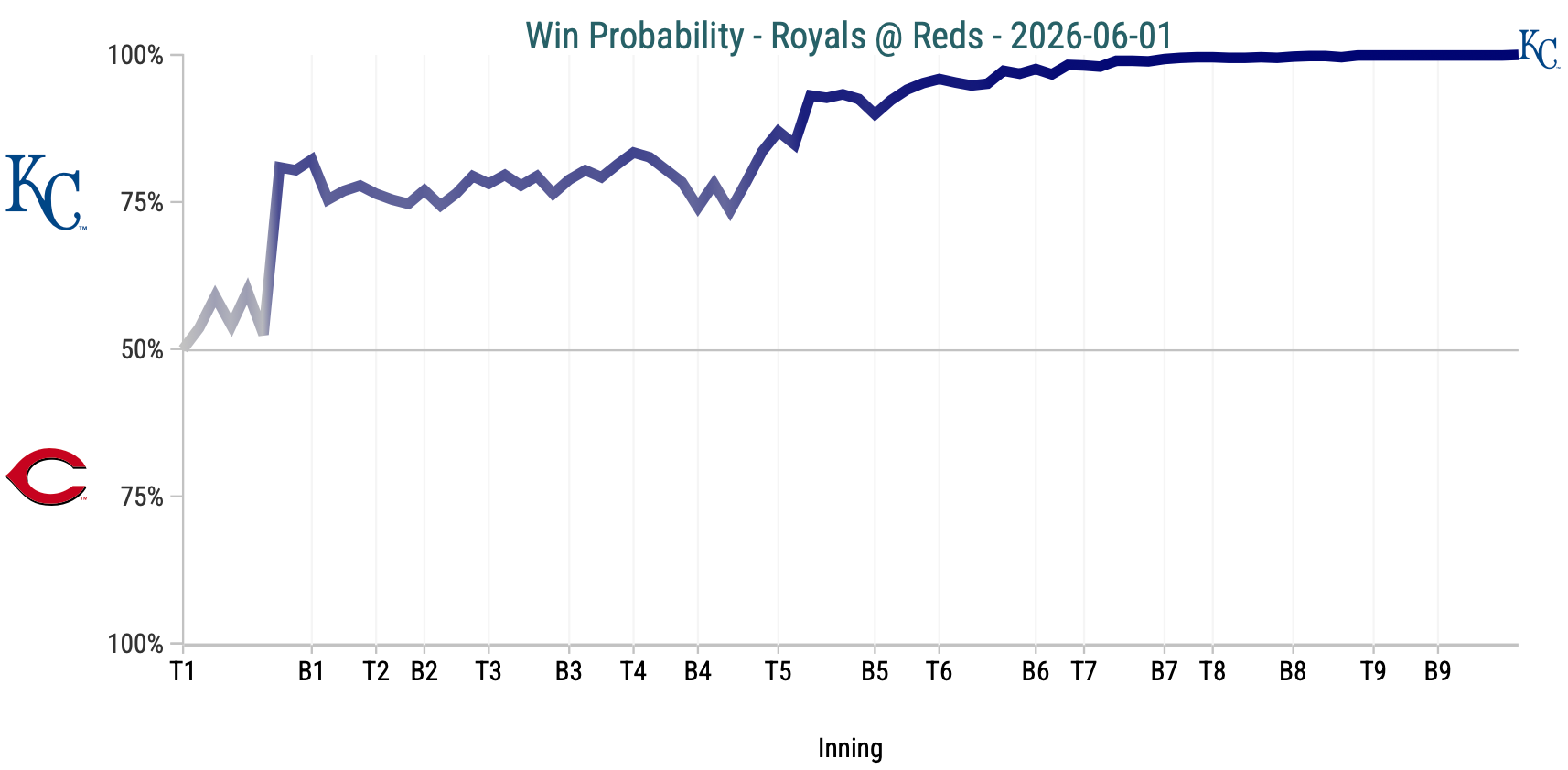
Naturally, the game wasn't over after the top of the first. While Thomas' swing provided the early edge, the win was secured from a total team effort. Starter Luinder Avila pitched five innings with the only blemish being a first-inning solo home run. Credit to him for keeping the advantage the Royals handed him. The bullpen added four innings where they collectively allowed one run. Caglianone drove in two runs. Entering the game, no qualified hitter had fewer RBI's than Caglianone. Pasquantino, after his poor showing in the first, collected two hits. It's the third time in four games he's collected a pair of knocks. Thomas doubled later. Michael Massey chipped in with three hits.
It was a team win, but it was one, individual swing that set this team on the path to victory.
Comments ()